.png)

Designing a loyalty or incentive program that actually changes behavior can be harder than it sounds. Most loyalty programs default to a simple formula: set a target, reward whoever hits it, repeat. But this one-size-fits-all approach ignores a fundamental truth about human motivation — different people (and companies) respond to different triggers, at different moments, in different ways.
That's precisely the problem that S-GRIT, Fielo's proprietary behavioral incentivization framework, was built to solve. Embedded exclusively within Fielo's platform, S-GRIT gives program designers an unprecedented level of control over how incentives are structured, measured, and delivered — making it one of the most powerful tools available today for building high-performing loyalty and incentive strategies.
What Is S-GRIT?
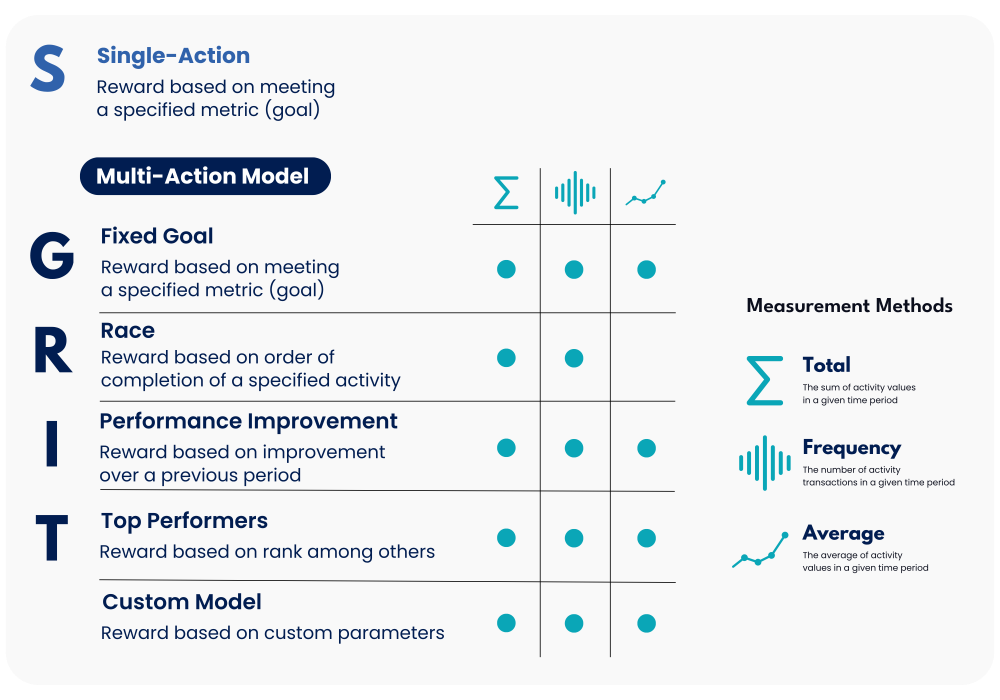
S-GRIT stands for:
- Single-Action
- (Multi-Action) Fixed Goal, Race, Performance Improvement and Top Performers.
%20800.png)
Five core performance models that define how rewards are earned within a program. Far more than a naming convention, S-GRIT represents a complete behavioral incentivization philosophy: the idea that every participant in a loyalty or incentive program has a distinct motivational profile, and that a truly effective strategy must be able to speak to each of them.
Whether the goal is to boost sales among channel partners, increase purchase frequency among customers, or deepen overall engagement across a network, S-GRIT provides the structural flexibility to design programs that feel personalized and gamified — because they are. This is what separates modern incentive strategy from outdated, blanket reward schemes. For the complete overview, see our guide to incentive loyalty programs.
Book a Demo
Performance Models: A Framework Built Around Human Behavioral Challenges
Each letter in S-GRIT maps to a distinct performance model, and each model is designed to activate a different behavioral driver.
- The Single-Action (S) model is the entry point — It rewards participants for completing one defined activity, for every time they complete the activity. It's ideal for onboarding and quick-win moments.
- Customer loyalty example: A customer earns 200 points every time they write a product review. Each review submitted triggers an automatic reward — no thresholds, no waiting — encouraging repeat engagement and user-generated content from day one.
- Channel incentive example: A reseller earns a $50 SPIFF for every new deal registered in the partner portal. Each registration counts individually, giving reps an immediate, tangible reason to keep pipeline data current and accurate.
- Multi-Action models — They reward participants for completing multiple activities in a specified time period, using the total, average, or frequency of those activities as the measure (see below).
- The Fixed Goal (G) model takes things further by rewarding participants for reaching a specific metric. This works well for structured incentive programs where clear targets drive predictable performance.
- Customer loyalty example: A customer earns 1,500 bonus points for spending $500 across any category within a single quarter. Fielo's gamified challenges track progress in real time, keeping members motivated as they approach the threshold.
- Channel incentive example: A reseller earns a performance bonus for closing $55,000 in total product sales within a 90-day campaign window. Fielo's dashboards surface each partner's progress automatically, reducing manual tracking overhead.
- The Race (R) model introduces competitive urgency: participants are rewarded based on the order in which they complete a goal — making it a powerful tool in incentives strategy when speed and competitive motivation are the desired behavioral levers.
- Customer loyalty example: The first 50 loyalty members to complete a seasonal purchase challenge earn exclusive double-points status for the following month — driving early, concentrated buying activity that benefits both the brand and the most engaged customers.
- Channel incentive example: The first three resellers to reach $10,000 in sales of a newly launched product line earn tiered cash bonuses — 1st place gets the highest payout, creating a competitive sprint that accelerates product adoption across the channel.
- The Performance Improvement (I) model is where S-GRIT truly distinguishes itself from conventional loyalty program design. Rather than rewarding based on absolute output, this model rewards participants for how much they improve relative to their own past performance.
- Customer loyalty example: A loyalty member who increases their monthly purchase frequency by 30% compared to the prior period earns a tier upgrade and bonus points — regardless of their absolute spend level, making the program inclusive for all customer segments.
- Channel incentive example: A small reseller who grows quarterly revenue from $10K to $20K receives the same reward rate as a large partner growing from $100K to $120K. Fielo's incentive automation calculates each partner's baseline and improvement automatically, ensuring fairness at scale.
A small channel partner who doubles their sales from $10K to $20K is rewarded just as meaningfully as a large partner who grows from $100K to $120K — even though the absolute numbers look very different. This creates a level playing field that encourages participation across the entire partner or customer base, not just the top tier.
- The Fixed Goal (G) model takes things further by rewarding participants for reaching a specific metric. This works well for structured incentive programs where clear targets drive predictable performance.
- Complementing this is the Top Performers (T) model, which ranks participants against each other and rewards based on relative standing — motivating the competitive segment of any audience and creating aspirational benchmarks that elevate the performance of the whole group.
- Customer loyalty example: At the end of each quarter, the top 20% of loyalty members by total purchases earn VIP status with exclusive early access to new products and premium rewards — creating aspirational benchmarks that motivate the broader member base to spend more.
- Channel incentive example: Resellers are ranked by average deal close time over a 3-month period, with the top tercile earning the highest reward tier. Fielo's performance analytics surfaces these rankings in real time, keeping the competitive dynamic visible and motivating throughout the program.
- Complementing this is the Top Performers (T) model, which ranks participants against each other and rewards based on relative standing — motivating the competitive segment of any audience and creating aspirational benchmarks that elevate the performance of the whole group.
Precision Through Measurement: Total, Frequency, and Average
.png)
What makes S-GRIT especially powerful as a loyalty strategy tool is that each of the five performance models can be combined with three distinct measurement methods, creating a rich matrix of incentive configurations:
- Total (the sum of activity values in a period)
- Frequency (the number of transactions)
- Average (the mean value of activity over time)
A Fixed Goal program, for instance, can reward participants for reaching a total sales figure, for closing a set number of deals, or for maintaining a deal-close time below a given average. A Race can be run on total revenue, deal count, or speed metrics. This level of granularity means that Fielo's clients can align their incentive programs precisely with the business outcomes that matter most — whether that's volume, velocity, or consistency.
A Custom Model and the Fielo Advantage
Beyond the five models, S-GRIT also includes a Custom Model that allows program designers to define bespoke reward structures — such as front-loaded incentives that award more points in the early weeks of a campaign to generate early momentum, or "raise the bar" mechanics that dynamically increase targets as participants achieve them.
This adaptability is the hallmark of a mature incentives strategy, one that evolves alongside participant behavior rather than remaining static.
As an exclusive feature embedded within our platform, S-GRIT is not an add-on or a third-party integration — it is the core engine of how Fielo helps companies build loyalty programs and channel incentive programs that deliver measurable, lasting results. For organizations looking to move beyond generic reward schemes and invest in a behavioral incentivization approach that truly drives sales, purchases, and engagement, S-GRIT is the framework that makes it possible.
Frequently Asked Questions
What is S-GRIT?
S-GRIT is Fielo's proprietary behavioral incentivization framework, built into the platform to give program designers precise control over how rewards are structured, measured, and delivered. Rather than relying on a single reward formula, it offers five distinct performance models — plus a Custom Model — so a program can speak to the different motivational profiles found across a partner network or customer base.
What does the acronym S-GRIT stand for?
It stands for Single-Action, and the Multi-Action group of Fixed Goal, Race, Performance Improvement, and Top Performers. Together these five models define the different ways participants can earn rewards within a program.
Is S-GRIT used for channel programs, customer loyalty programs, or both?
Both. S-GRIT is designed to work across use cases — whether the goal is boosting sales among channel partners and resellers, or increasing purchase frequency and engagement among retail customers. The same five models apply in either context; only the specific triggers and rewards change. For example, the Single-Action model can pay a reseller a SPIFF for every new deal registered in a partner portal, while in a customer loyalty program that same model can award points every time a customer writes a product review. Because the underlying framework is identical, brands running both a channel incentive program and a customer loyalty program can apply consistent, proven mechanics across each — just tailored to the audience.
What is the Single-Action (S) model, and when should it be used?
Single-Action rewards a participant every time they complete one defined activity — no thresholds or waiting periods. It's best suited for onboarding and quick-win moments, such as rewarding a customer for each product review or a reseller for each deal registered.
How does the Fixed Goal (G) model work?
Fixed Goal rewards participants once they hit a specific target metric, such as a sales total or spend threshold within a set time period. It suits structured programs where clear, predictable targets drive performance, and Fielo's dashboards track progress toward the goal automatically.
What makes the Race (R) model different from Fixed Goal?
While Fixed Goal rewards anyone who reaches a target, Race rewards participants based on the order in which they reach it — introducing competitive urgency. It's effective when speed matters, such as rewarding the first resellers to hit a sales milestone on a new product line, or the first loyalty members to complete a seasonal challenge.
What is the Performance Improvement (I) model, and why is it considered unique?
This model rewards participants for how much they improve relative to their own past performance, not their absolute output. That means a small partner growing from $10K to $20K in sales can earn the same reward as a large partner growing from $100K to $120K. This levels the playing field and encourages participation across an entire partner or customer base, not just top performers.
How does the Top Performers (T) model work?
Top Performers ranks participants against each other and rewards relative standing — for example, the top 20% of loyalty members by purchases, or resellers ranked by average deal-close time. It's designed to motivate the most competitive segment of an audience while setting aspirational benchmarks for everyone else.
What are the "Total," "Frequency," and "Average" measurement methods, and how do they relate to the five models?
These are three ways to measure activity within any of the five performance models: Total (the sum of activity in a period), Frequency (the number of transactions), and Average (the mean value over time). Because each model can be paired with any of these three measurements, S-GRIT creates a broad matrix of configurations — for instance, a Race can be run on total revenue, deal count, or speed — letting programs align precisely with the outcomes that matter, whether that's volume, velocity, or consistency.
What is the S-GRIT Custom Model, and why would a program need it?
Beyond the five core models, S-GRIT includes a Custom Model for bespoke reward structures that don't fit a standard pattern — such as front-loaded incentives that pay more in a campaign's early weeks, or "raise the bar" mechanics that increase targets as participants hit them. It gives program designers room to evolve incentive strategy alongside actual participant behavior rather than keeping it static. As AI capabilities evolve, the question of how much autonomy to give AI in loyalty programs becomes critical.