Loyalty Program Marketing is a relationship-driven strategic approach focused on growing and retaining an existing customer base by offering targeted incentives that drive profitable behaviors. Here's what to remember from this guide:
Loyalty marketing shifts consumer relationships from purely transactional exchanges to deep emotional connections that protect margins and reduce churn. By leveraging data, personalized rewards, and agile technologies to avoid program staleness, businesses can build self-sustaining cycles of trust and create powerful brand advocates.
In an era where consumers are bombarded with endless choices, winning a transaction is no longer enough; brands must win the customer's ongoing preference. This is where loyalty program marketing becomes a critical business engine. Rather than allocating endless budgets into acquiring new leads, companies use loyalty program marketing to maximize the value of the audience they already have. In this comprehensive guide, you will learn exactly what loyalty marketing is, how it differs from traditional marketing, the most effective program types, key measurement metrics, and how to build a successful strategy while avoiding common pitfalls.
Loyalty marketing is a relationship-driven strategy designed to grow and retain a company's existing customer base. It relies on offering incentives—such as points, exclusive experiences, tier upgrades, or discounts—to motivate specific, profitable behaviors.
While traditional promotions often treat buyers like "perfect strangers," modern loyalty marketing acts as a customer intelligence engine. By rewarding customers for their engagement, brands gather valuable zero-party data. This data is then used to hyper-personalize future communications and offers, building a self-sustaining cycle of trust, relevance, and emotional connection that keeps customers returning.
Loyalty program marketing is no longer just an ancillary tactic; it is a central driver of profitability and business resilience. Implementing a structured program is critical for businesses looking to protect their margins and grow sustainably.
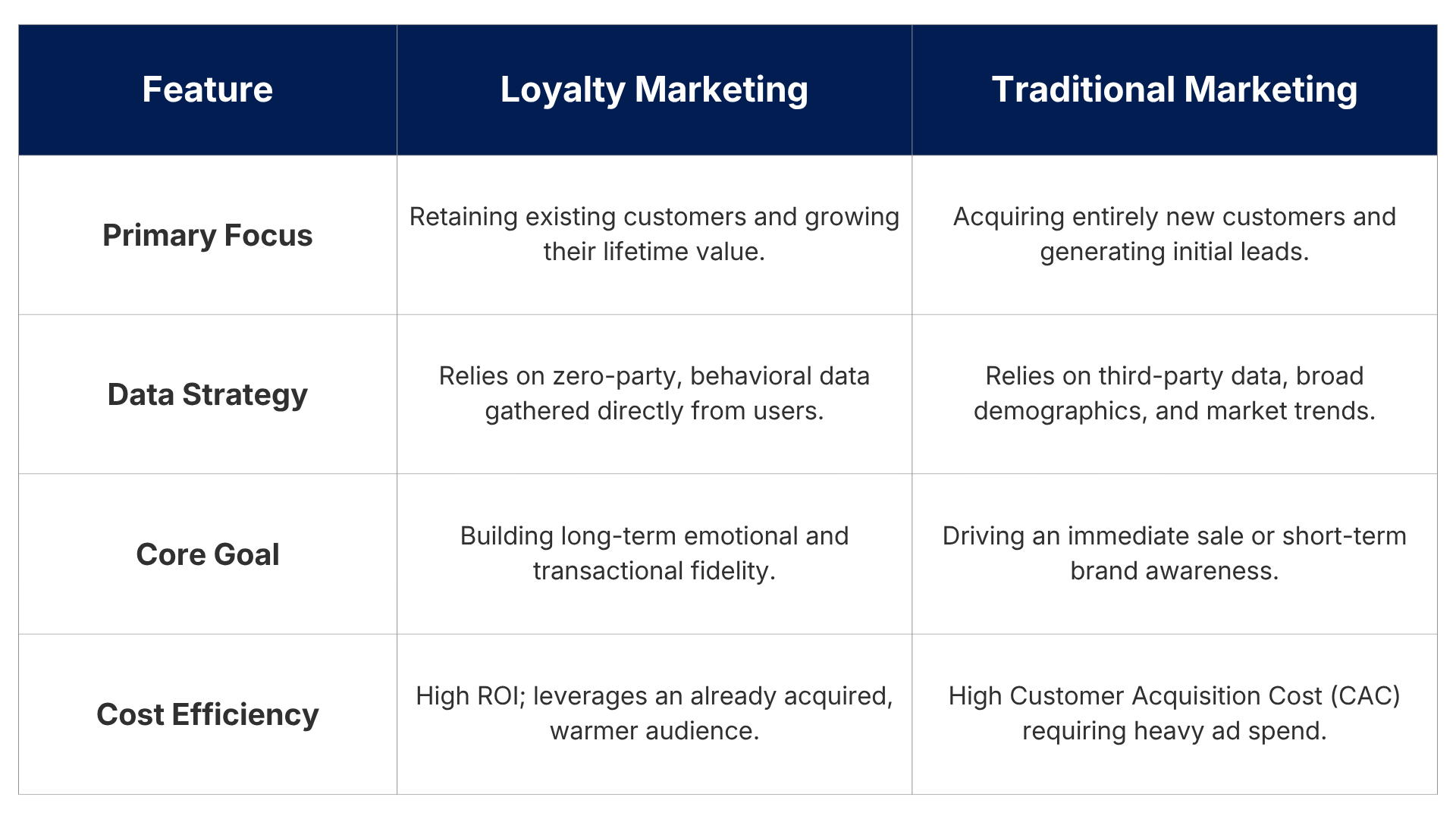
While both aim to drive revenue, their focus and execution are fundamentally different.
Businesses tailor their loyalty structures to fit their industry and audience expectations.
To avoid running programs in the dark, businesses must monitor specific Key Performance Indicators (KPIs):
Even with the best intentions, loyalty program marketing can fail if poorly designed. The most common pitfall is excessive complexity; if rules are confusing or redemption is too bureaucratic, customers feel cheated and leave. Another major challenge is staleness, where a "set-and-forget" mentality leads to boring programs with no new challenges or gamification to keep users engaged. Additionally, failing to segment audiences leads to irrelevant, generic rewards that do not match the customer's lifestyle or effort, causing participation to plummet.
Loyalty program marketing is an essential strategy for retaining customers and maximizing their lifetime value through intelligent behavioral incentives. Top programs move past simple points to focus heavily on emotional connections, gamification, and VIP experiences. By leveraging highly valuable zero-party data, brands can deliver personalized offers that significantly increase cross-sell conversions.
Measuring this success requires looking beyond simple enrollments and actively tracking engagement, redemption rates, and ROI. To avoid complexity, maintain omnichannel consistency, and regularly introduce fresh campaigns, companies are turning to smart, integrated platforms. Solutions like Fielo offer an AI-native Loyalty Copilot that helps brands quickly co-create tailored blueprints, automate complex rules, and predict churn, reducing program design cycles by up to 70% while guaranteeing highly engaging experiences.
It is a strategic marketing approach focused on growing and retaining existing customers by offering targeted incentives, personalized experiences, and rewards that drive ongoing engagement and repeat purchases.
Loyalty marketing is the overarching strategy and discipline of retaining customers. A loyalty program is the specific, structured ecosystem (the technology, rules, and rewards) used to execute that marketing strategy.
It works by presenting incentives to customers to motivate profitable behaviors. As customers engage, the brand collects behavioral data, which is then used to deliver personalized offers that keep the customer coming back.
It increases customer lifetime value, boosts average order sizes, reduces customer churn, provides valuable zero-party data for personalization, and creates organic brand advocates.
Examples include airline frequent flyer miles, cruise line loyalty programs, tiered VIP access for luxury retail shoppers (like Clarins), or gamified apps that reward customers for frequent store visits.
The most common types are points-based systems, tiered aspirational programs, gamified challenges, and coalition programs shared across multiple partner brands.
ROI is measured by tracking incremental revenue generated by members, their repeat purchase frequency, the program's active member rate, and the overall redemption rate of rewards.
Key challenges include designing overly complex rules, offering irrelevant rewards, failing to integrate the experience across physical and digital channels, and letting the program become stale.
Small businesses can utilize agile, cloud-based loyalty software to implement simple points or digital punch-card programs, rewarding their most frequent local buyers without requiring massive IT budgets.
Traditional marketing focuses heavily on spending money to acquire new customers. Loyalty marketing focuses on maximizing the profitability and retention of the customers a business has already acquired.

.png)