Top Winning Examples Of Loyalty Programs For Retailers
Top Winning Examples Of Loyalty Programs For Retailers
Key Takeaways
A retail customer loyalty program is a strategic marketing ecosystem designed to encourage repeat business and deepen brand engagement by offering incentives to frequent shoppers. Here's what to remember from this guide:
Retail loyalty programs are vital intelligence engines. By rewarding buyers, brands naturally collect behavioral data, allowing them to deliver hyper-personalized promotions that can boost annual member revenue significantly.
There are multiple structures to fit different audiences. Winning retail store loyalty programs utilize a mix of points-based systems, gamified tiers, paid subscriptions, and experiential rewards tailored to their specific consumer base.
Top brands blend transactional and emotional rewards. Market leaders like Sephora and Starbucks excel in experiential and mobile integration, while enterprise successes like Clarins leverage omnichannel data to unify the in-store and digital experience.
Simplicity and freshness are mandatory. Excessive complexity, lack of personalization, and a "set-and-forget" mentality lead to boring retail store loyalty programs that quickly erode customer trust and participation.
Implementing an effective retail store loyalty program is the first step toward building deeper customer relationships, but to do so, it's necessary to avoid falling into the trap of sameness. Best-in-class programs go far beyond basic punch cards by delivering highly personalized, frictionless experiences.
By investing in the right strategy and technology, retailers can shift casual shoppers into devoted brand advocates, maximizing long-term profitability and market share. In an increasingly crowded market, capturing a customer’s attention for a single transaction is only half the battle. To truly scale, businesses need retail store loyalty programs that foster ongoing relationships.
While many brands launch customer loyalty programsin retail, those that succeed move beyond 101 strategies to deliver highly personalized, omnichannel experiences. In this comprehensive guide, you will learn what defines a successful retail strategy, the core types of retail loyalty rewards programs, the most common mistakes to avoid, and discover real-world retail loyalty programs examples from industry-leading brands.
What Is a Retail Loyalty Program?
A retailcustomer loyalty program is a strategic marketing ecosystem designed to encourage repeat business by offering incentives—such as points, discounts, cashback or VIP experiences—to customers who frequently engage with or purchase from a brand. In the retail sector, these retail store loyalty programs act as vital intelligence engines. By rewarding buyers, brands naturally collect behavioral data, which allows them to offer hyper-personalized promotions that elevate the overall customer experience and drive ongoing revenue.
Why Retail Loyalty Programs Matter
Investing in loyalty programs in retail marketing yields profound financial and behavioral benefits. Relying on transactional discounts alone erodes brand value, whereas structured customer loyalty for retailers builds trust and long-term engagement.
Consider these industry statistics:
Explosive Market Expansion: Industry forecasts from Research and Markets indicate the global loyalty sector is on track to hit a staggering US$214.7 billion by 2028.
Driving Buying Decisions: 63% of consumers actively base their purchasing choices on the specific loyalty programs they belong to, shows findings from a Bain & Company/ROI Rocket survey.
Accelerating Top-Line Revenue: High-performing loyalty initiatives can elevate annual revenue from program members steadily driving up transaction frequency and overall order values.
Types of Retail Loyalty Programs
The best loyalty programs for retail come in various structures tailored to specific audience preferences. Here is a brief overview:
Points-Based Programs: Customers earn currency for purchases, which can be redeemed for discounts or free products.
Tiered Programs: Creates an aspirational journey (e.g., Silver, Gold, Platinum) where reaching higher status levels unlocks exponentially better perks.
Gamified Programs: Utilizes leaderboards, badges, and progress streaks to make the shopping experience inherently fun and competitive.
Paid/Subscription Programs: Customers pay an upfront fee for immediate, ongoing benefits (like free shipping or exclusive access).
Experiential Programs: Focuses on non-monetary rewards such as VIP event access, early product drops, or personalized styling sessions.
Top Winning Examples of Retail Loyalty Programs
Here are 10 of the best customer loyalty programs in retail firms, combining real-world B2C client successes powered by Fielo's technology with widely recognized global examples:
Clarins (Club Clarins)
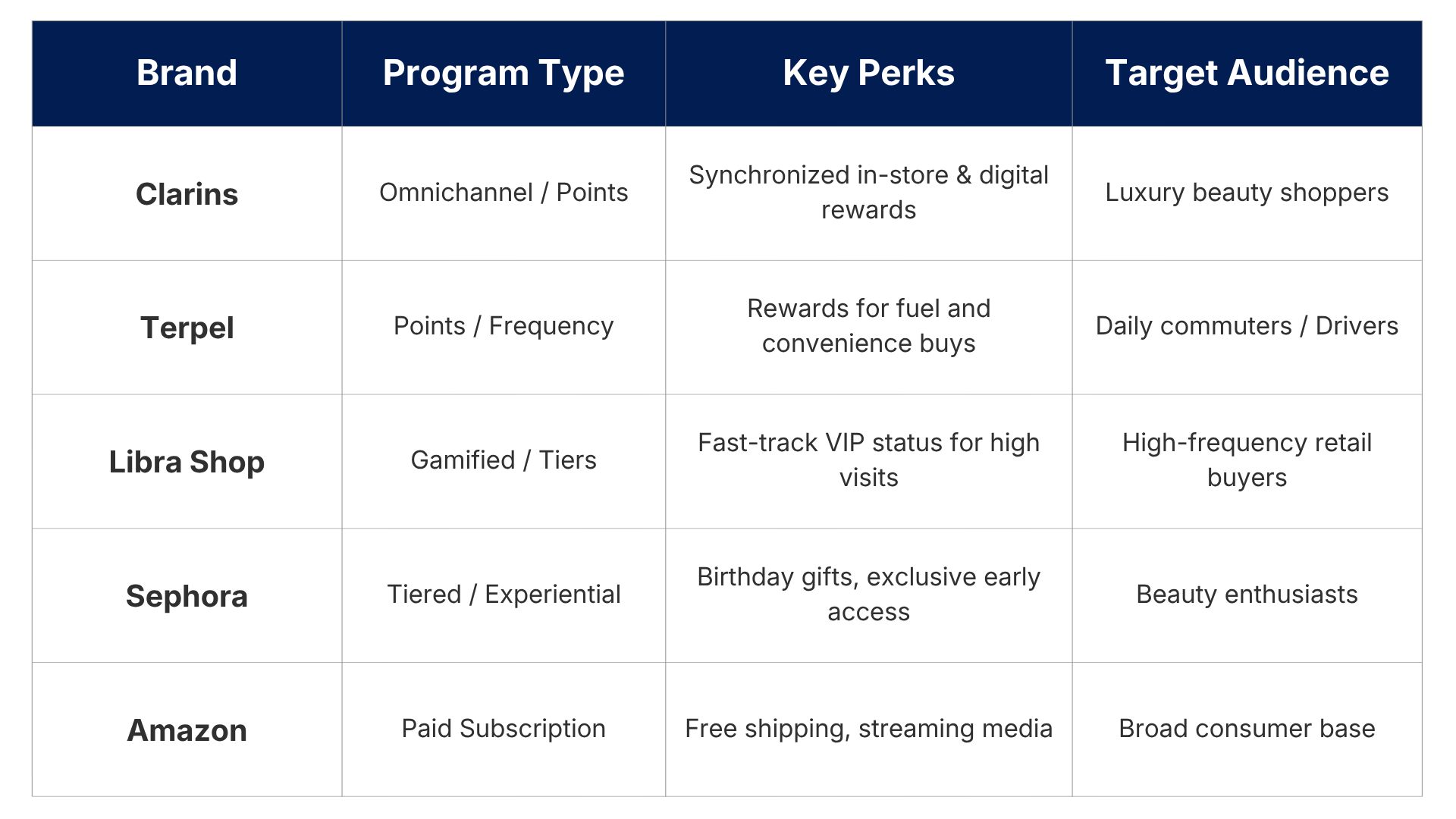
Key Features: A luxury omnichannel points program synchronizing data across e-commerce and in-store department counters.
Why it works: By connecting multiple entrances, Clarins manages all client information in one place, allowing them to deliver a highly personalized, premium brand experience seamlessly.
Terpel (Vive Terpel)
Key Features: A massive oil and gas retail points program rewarding transactions at the pump.
Why it works: It captured 750,000 new users in one year. By incentivizing daily habits, the program directly drove half of the company's 2% total market share gain.
Libra Shop (Club Libra)
Key Features: A gamified retail program using an in-store iPad kiosk and a member portal.
Why it works: They used extreme gamification—the first 50 members to visit the store 40 times automatically leveled up to the Gold Tier, driving massive repeat foot traffic.
Tienda Inglesa (Programa Puntos)
Key Features: A multi-tier supermarket program that tracks and controls grocery points.
Why it works: It automated previously manual reward tracking, making the redemption process frictionless for thousands of daily grocery shoppers.
Mercedes-Benz (Mercedes.me)
Key Features: A localized retail space experience in Beijing where customers accumulated and redeemed points within the shopping center.
Why it works: It blended luxury automotive branding with tangible, immediate lifestyle and retail rewards in a physical space.
Sephora (Beauty Insider)
Key Features: A highly aspirational tiered program (Insider, VIB, Rouge) offering points, birthday gifts, and exclusive event access.
Why it works: It perfectly blends transactional discounts with emotional, experiential rewards, creating a fierce desire to reach the top tier.
Starbucks (Starbucks Rewards)
Key Features: A spend-based mobile app program where "Stars" unlock free food and drinks.
Why it works: Its seamless mobile ordering and payment integration makes convenience the ultimate driver of repeat visits.
Amazon (Amazon Prime)
Key Features: A paid subscription program offering free fast shipping, streaming, and exclusive sales.
Why it works: The upfront investment completely shifts consumer psychology, making Amazon the default choice to maximize the subscription's value.
Target (Target Circle)
Key Features: A free points-based program integrated with highly personalized discount offers.
Why it works: It uses vast amounts of purchasing data to offer targeted discounts on items the consumer already buys regularly.
Nike (Nike Membership)
Key Features: An experiential program offering free shipping, exclusive shoe drops, and access to fitness apps.
Why it works: It builds a community around an active lifestyle rather than just pushing product discounts.
Quick Comparison of Top Retail Loyalty Programs
How to Choose the Right Loyalty Program for Your Retail Business
To implement successful retail customer loyalty solutions, you need a strategic approach that combines clear objectives with the right technology. Here is how to build a program that drives real results:
Define Your Core Business Goals: Begin by identifying exactly what you want to achieve—such as increasing foot traffic, boosting the average basket size, or preventing customer churn. To be truly effective, align these goals with specific customer behaviors you want to encourage, such as brand engagement, referrals, or community participation, rather than just focusing on purchase transactions.
Understand and Segment Your Audience: Once your goals are set, analyze your audience data to determine what rewards they actually value. Use dynamic, criteria-based segmentation to tailor your offers and journeys to different customer profiles, such as "Big Spenders," reliable "Regulars," or vocal brand "Advocates".
Design Meaningful and Attainable Rewards: Make sure your catalog offers a mix of transactional benefits (like discounts or cashback) and non-transactional perks (like exclusive experiences or community events). The perceived value of the reward must always correlate with the effort required to obtain it, keeping customers motivated without frustrating them.
Invest in a Scalable Retail Loyalty Platform: Choose a system that integrates natively with your existing point-of-sale and CRM infrastructure. Look for platforms with a no-code, point-and-click interface; this allows your marketing and sales teams to automate complex rules and manage the retail store loyalty programs independently, drastically reducing heavy IT reliance and speeding up your time-to-market.
Ensure Omnichannel Consistency: Your chosen platform must unite all of your brand's touchpoints. Customers should be able to seamlessly earn and redeem their rewards whether they are shopping on your website, using your mobile app, or visiting your physical retail stores.
Leverage AI for Continuous Optimization: To keep the program from going stale, utilize AI-native tools that can act as a strategic assistant. Modern AI can analyze member behavior to recommend new campaign structures, proactively predict and prevent customer churn, and flag anomalies to reduce fraud risk
Common Mistakes to Avoid When Building a Retail Loyalty Program
To keep your program fresh and avoid the most frequent pitfalls that cause initiatives to fail, make sure to steer clear of these common errors:
Meaningless or Unattainable Rewards: Setting goals that are too high, relying on heavy bureaucracy for redemption, or offering irrelevant perks will quickly discourage shoppers. Ensure the perceived value of the reward always matches the effort required to get it, and offer a mix of both transactional savings and emotional, non-transactional experiences.
Overlooking Your In-Store Team: Your retail associates are your best brand advocates. A major mistake is failing to train your front-line staff to effectively explain, promote, and activate loyalty benefits on the spot. If your employees aren't motivated or knowledgeable about the retail store loyalty programs , your customers won't be either.
Communication Failures (Spam or Silence): Bombarding your customers with too many generic messages or going completely silent will erode their trust and patience. Communication must be regular, highly relevant, and balanced according to the customer's preferences to maintain a healthy relationship.
Lack of Currency Liquidity (Breakage): If customers cannot easily spend their earned points, they will lose interest, leading to "breakage" (unredeemed points). This lack of engagement can even create fiscal liabilities on your company's balance sheet. Avoid this by offering flexible redemption options, such as fortune wheels, charitable donations, or partner exchanges.
Chasing Vanity Metrics: Measuring the wrong data, like simply counting total enrollment rates without looking at actual participation. A program might boast massive sign-ups, but if members aren't transacting, the program is failing. Focus your monitoring on clear KPIs like redemption frequency, breakage, and buying frequency to ensure real engagement
Conclusion
Cultivating customer loyalty in the retail industry is a powerful driver of long-term profitability and market share growth. The most successful retail store loyalty programs move past simple discounts, instead utilizing tiers, gamification, and experiential rewards to build lasting emotional connections with shoppers. Furthermore, omnichannel consistency—allowing users to seamlessly earn and redeem rewards across e-commerce and physical stores—is mandatory for modern retail success.
To build an intelligent, scalable program without manual headaches, retailers are turning to a modern retail loyalty platform like Fielo. The AI-native Fielo Loyalty Copilot helps brands co-create tailored blueprints, automate complex rules, and deploy campaigns in days.
Frequently Asked Questions
What is a retail loyalty program?
It is a structured marketing strategy that rewards retail customers with points, discounts, or exclusive perks in exchange for their repeated business and engagement.
What are the best loyalty programs for retail?
The best programs blend monetary rewards (like points and cashback) with emotional, non-monetary benefits (like VIP tiers and exclusive event access) tailored to the specific customer base.
What are examples of successful retail loyalty programs?
Successful examples include Clarins' omnichannel Club Clarins, Terpel's Vive Terpel gas station program, Sephora’s Beauty Insider, and Amazon Prime.
How do retail loyalty programs work?
Customers enroll and track their purchases or engagements. As they meet specific thresholds, the program's engine automatically issues rewards or elevates their tier status, encouraging further buying.
What makes a retail loyalty program successful?
Success requires simple rules, meaningful and attainable rewards, highly personalized communication based on customer data, and seamless omnichannel integration across web and physical stores.
Which retail brands have the best loyalty schemes?
Brands like Sephora, Starbucks, Amazon, and Target are widely recognized for their market-leading programs, alongside enterprise successes like Terpel and Clarins.
How do small retailers build a loyalty program?
Small retailers can use a scalable, cloud-based retail loyalty platform with plug-and-play points rules and digital rewards, eliminating the need for expensive custom software development.
What is the ROI of a retail loyalty program?
While it varies by execution, effective loyalty programs report an average ROI of 5.3x, driven by increased purchase frequencies and larger average basket sizes.


.png)