
.png)

Deloitte’s Manufacturing Industry Outlook identifies a number of key challenges for manufacturing leaders in the months ahead. A major one among them: “navigating persistent talent obstacles.” The report also suggests that embracing digital transformation will be essential to meeting those challenges. That raises a question we think about every day: How should manufacturers use digital technology to better enable channel partners?
The stakes are high. Manufacturers' growth depends on resellers, distributors, and dealers who represent them in front of customers every day. But partners can only sell what they understand. That's where partner enablement comes in. This guide explains what partner enablement is, how it differs from sales enablement, and which goals and KPIs to set. It then walks through a complete partner enablement checklist, from partner onboarding to measurement, and a step-by-step process for building your partner enablement strategy.
What Is Partner Enablement?
Partner enablement is the process of giving partners the knowledge, training, content, tools, and support they need to sell, market, implement, or support your offering. It covers everything from partner onboarding and partner education to sales playbooks, customer-ready assets, and ongoing coaching. Channel enablement is often used as a synonym, particularly when the partners are resellers and distributors in a traditional sales channel.
The goal is simple: partners who represent your brand as confidently and accurately as your own sales team.
Why Is Partner Enablement Important?
Partners typically work with several vendors at once, and they focus on the ones that are easiest to sell. Strong partner enablement makes you one of them. The business impact shows up in five areas:
- Better partner performance: According to a PartnerStack survey, partners who complete a training or certification course earn six times more from partner programs on average than partners who don't.
- Faster ramp-up: Structured onboarding shortens the time between signing a partner and closing their first deal. Payroll company Gusto found that partners certified through its academy brought in 40% more clients in the 90 days after certification than non-certified firms.
- Consistent customer experiences: Customers get the same accurate message and quality of service whichever partner they buy from.
- Stronger relationships: Partners who succeed with your products invest more in them and stay longer.
- Revenue growth: Enablement scales your reach without adding direct sales headcount.
Partner Enablement vs. Sales Enablement
Sales enablement supports your internal sales team. Partner enablement supports people who don't work for you, which changes almost everything about the approach.
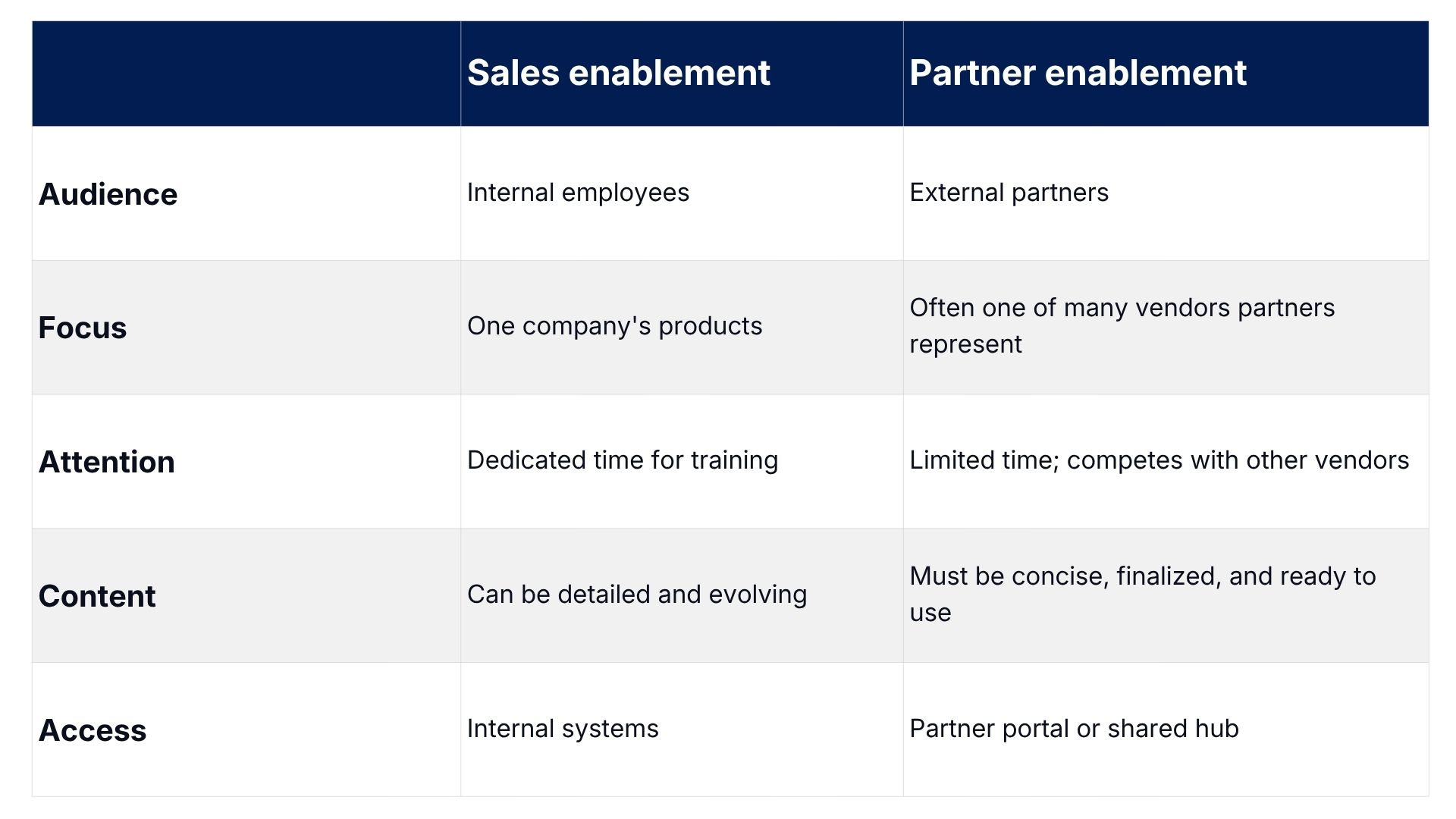
Forrester has noted that partner assets are often direct sales materials with minor adjustments, and that these fall short when enabling partners. Build for partners from the start.
Partner Types and Segmentation
Enablement should vary by partner type, role, and maturity. A one-size-fits-all program wastes partners' time on content they don't need.
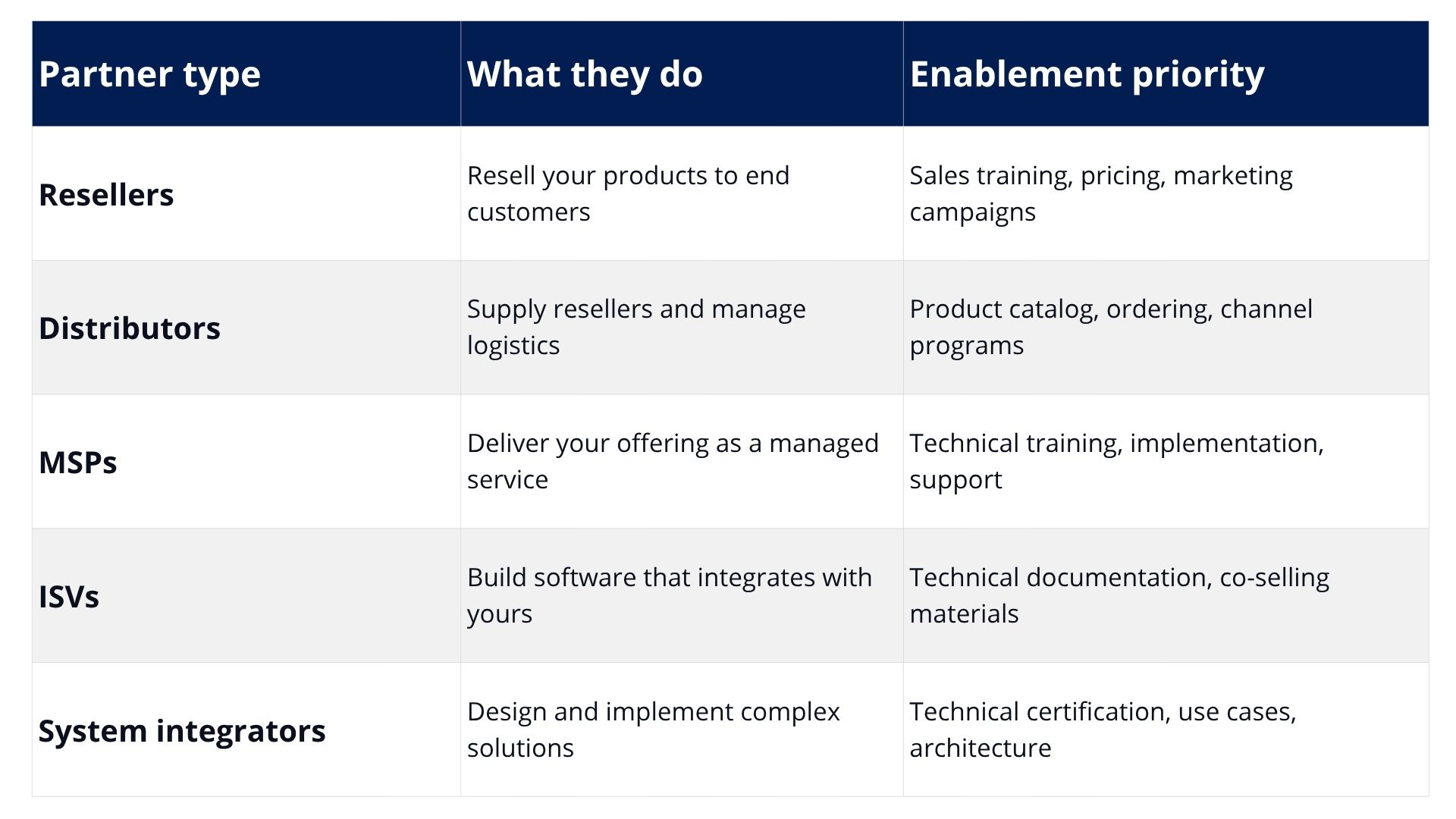
Within each type, segment further by role (sales, technical, marketing) and maturity (new, growing, strategic), so a new reseller rep gets foundational content while a veteran technical partner gets advanced certification.
Partner Enablement Goals and KPIs
Define success before you create any training or content. Track two types of metrics:
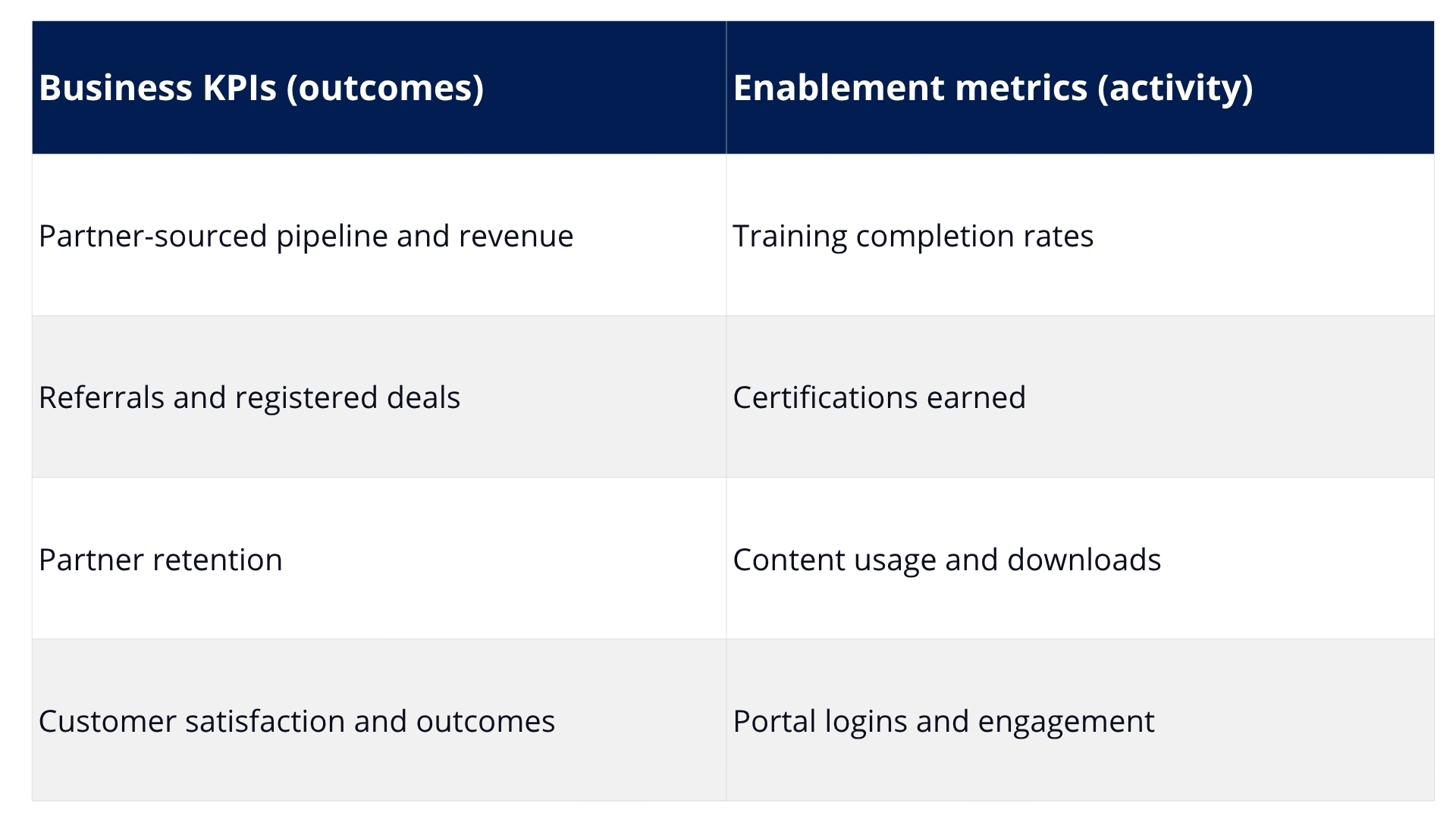
Enablement metrics show whether partners are engaging. Business KPIs show whether that engagement pays off. Set targets for each partner segment rather than one program-wide number. For example, you might aim to cut time to first deal for new resellers from 120 to 90 days, while asking strategic partners to grow sourced pipeline by 20%.
The Partner Enablement Checklist
Use this checklist to build or audit your program. The items are grouped by phase:
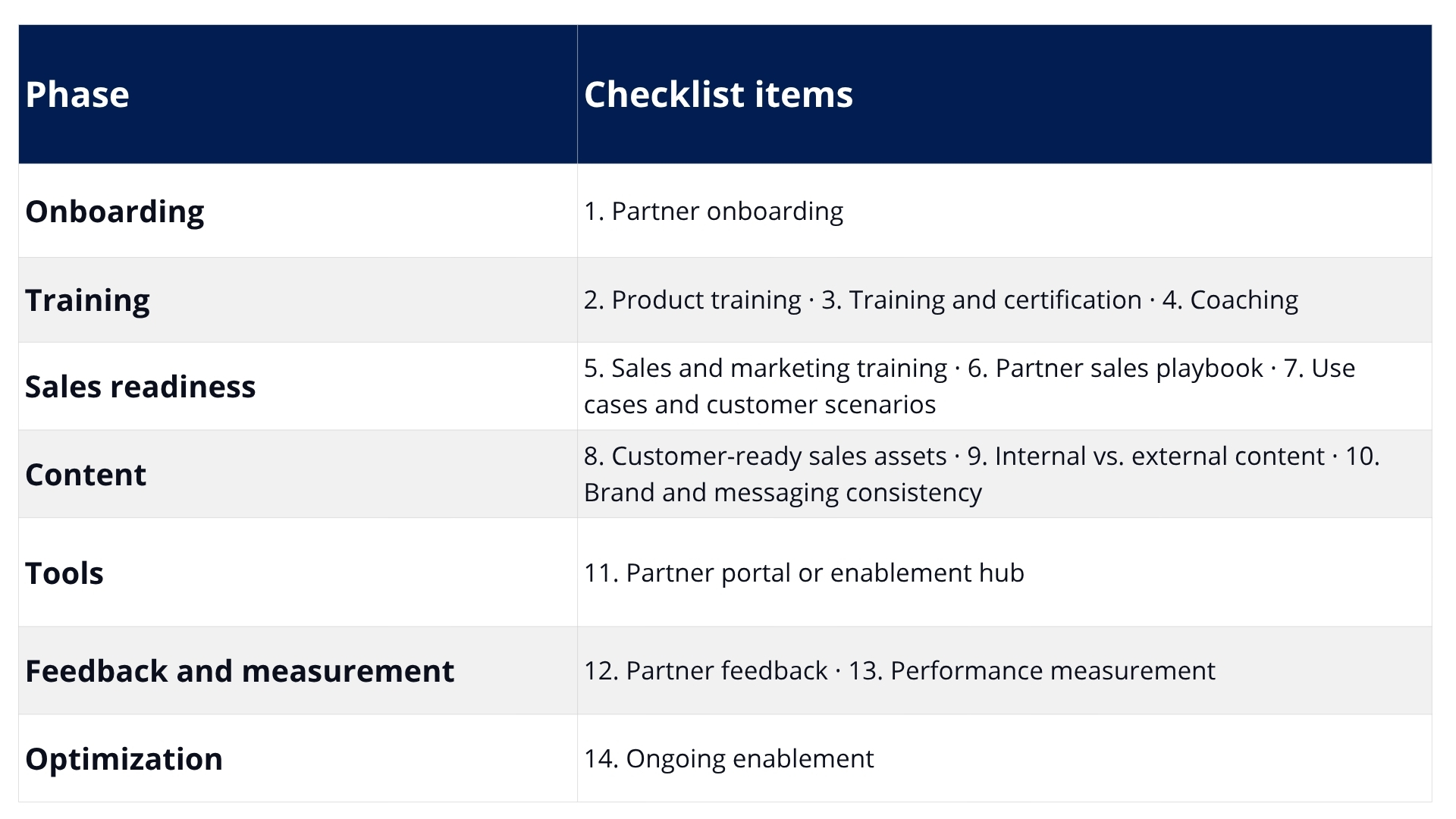
1. Partner Onboarding
Partner onboarding sets the pace for the whole relationship. Treat it as a structured program, not a welcome email. A simple structure is 30-60-90 days: set up access and complete foundational training in the first month, run joint calls and register a first opportunity in the second, and close a first deal or reach certification in the third.
- Define clear onboarding stages with milestones toward the first deal
- Assign role-based learning paths for sales, technical, and marketing staff
- Provide portal access and a quick tour on day one
- Deliver initial product training in the first weeks
- Track time to first deal as a core onboarding metric
2. Product Training
Partners must know your products deeply enough to sell them with confidence.
- Cover features, benefits, and use cases
- Be honest about limitations, so partners set the right expectations
- Explain competitive differentiation
- Provide product guides, demos, and short videos
- Use interactive formats such as simulations, quizzes, and gamification
- Share product updates as soon as they launch
3. Training and Certification
Partner education only works if partners retain it. Assessments and certifications show whether partners have actually learned the material, and they give partner managers a clear signal of who is ready to sell and who needs more support.
- Add assessments and quizzes to every training module
- Offer certifications that prove competency and unlock benefits
- Schedule refresher training for product and market changes
- Reward progress through programs such as Learn & Earn
4. Coaching
Coaching turns knowledge into results by helping partners apply best practices in real sales situations. Training tells partners what to do; coaching helps them do it in front of a customer, which is where most skill gaps appear.
- Hold regular coaching sessions led by partner managers
- Use deal reviews to identify skill gaps
- Share examples from top-performing partners
- Follow up training with practical application
5. Sales and Marketing Training
Give partners specific tools to win customers, not generic advice.
- Provide key messaging and value propositions
- Teach discovery guidance and objection handling
- Supply battlecards and pitch decks
- Offer ready-to-use, co-brandable marketing campaigns
- Support lead generation and nurturing
6. Partner Sales Playbook
A partner-facing playbook gives partners one place to learn how to sell your offering.
- Ideal customer profile (ICP) guidance
- Positioning and value messaging
- Discovery questions
- Sales plays by segment or use case
- Objection handling and competitive talk tracks
- Pricing and packaging guidance
7. Use Cases and Customer Scenarios
Real-world scenarios help partners turn product knowledge into customer conversations.
- Describe who each product is for
- Explain the problem it solves
- Show how partners should position it in that situation
8. Customer-Ready Sales Assets
Partners need assets they can use with customers immediately, without editing.
- Pitch decks and presentations
- Case studies and one-pagers
- Battlecards and FAQs
- Demos and videos
- Make every asset easy to find and clearly labeled
9. Internal vs. External Partner Content
Not every asset serves the same purpose. Separate content into two groups:
- Internal content that partners use to learn and sell, such as training, playbooks, and battlecards
- External content that partners share with customers, such as decks, case studies, and one-pagers
- Label each asset clearly so partners never send internal material to customers
10. Brand and Messaging Consistency
Partners represent your brand, so they need clear guardrails.
- Publish brand guidelines and usage rules
- Provide approved messaging partners can reuse word for word
- Keep one central, updated source of approved content and retire outdated versions
11. Partner Portal or Enablement Hub
A partner portal should be the single source of truth for everything partners need, not a collection of scattered files. Make it searchable, mobile-friendly, and personalized by partner type, so each partner sees what's relevant to them first. Include:
- Latest training and certifications
- Sales assets and playbooks
- Product updates and announcements
- FAQs and support contacts
12. Partner Feedback
Partners know what's working in the field. Use their input to shape future content and training.
- Run regular partner surveys
- Host Q&A sessions and office hours
- Create a partner advisory group for strategic partners
- Review feedback in quarterly business reviews (QBRs)
- Show partners what changed because of their feedback
13. Partner Performance Measurement
- Track leading indicators: training completion, content usage, and certifications
- Track business outcomes: pipeline, revenue, win rate, time to first deal, and partner retention
- Connect the two to see which enablement activities drive results
- Use analytics and reporting to compare partners and segments
14. Ongoing Enablement
Enablement doesn't end after onboarding. Markets, products, and competitors change, and partners need regular updates to stay effective. A practical cadence is a monthly partner update and a quarterly review of training and assets. Plan updates for:
- New products and features
- Competitive changes
- Updated messaging
- Certification renewals
- New best practices from top partners
Technology for Partner Enablement
The right technology makes enablement scalable. Match each tool to the need it solves:
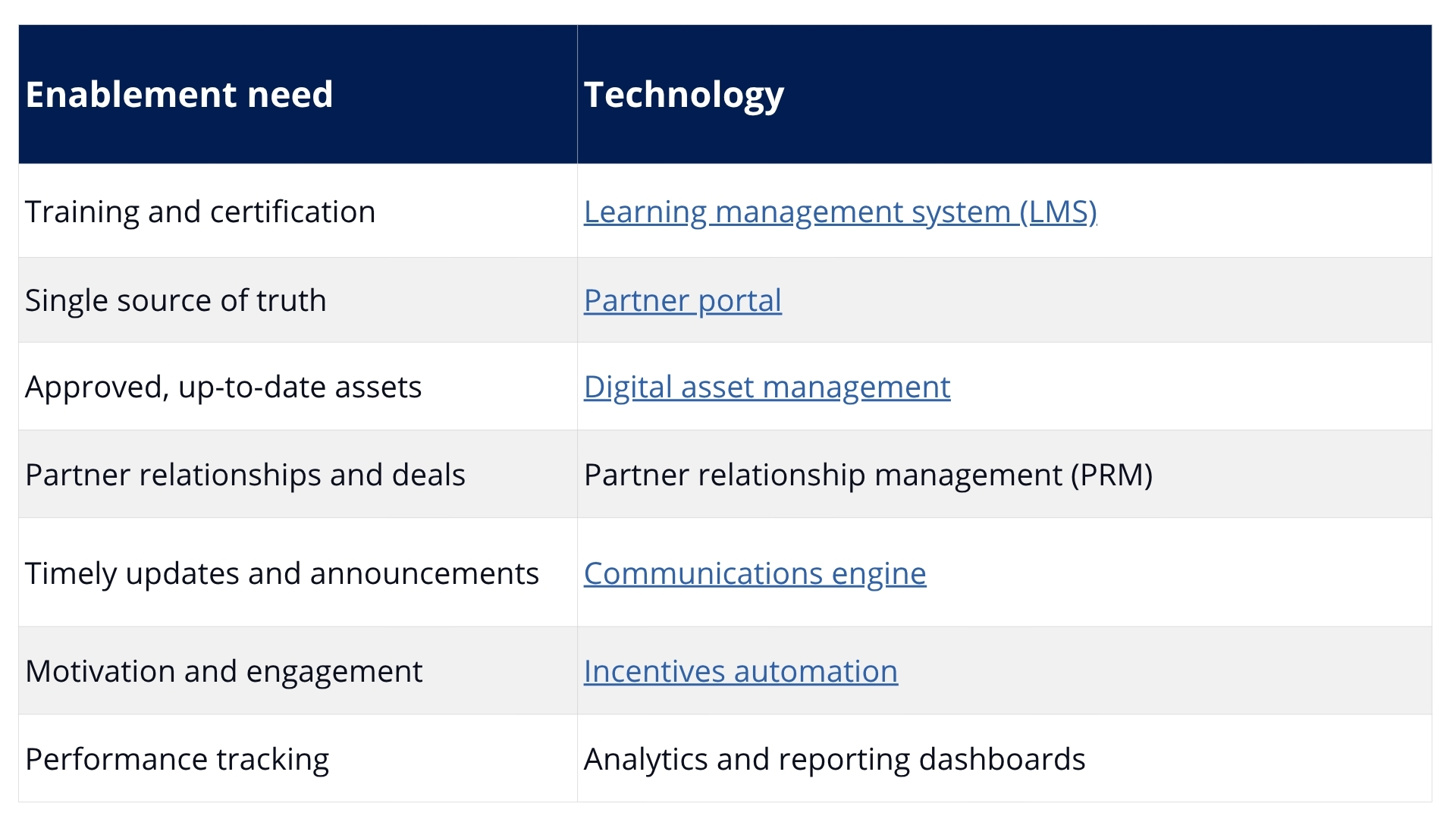
For tips on adoption, read our guide to PRM portal utilization.
Common Partner Enablement Challenges
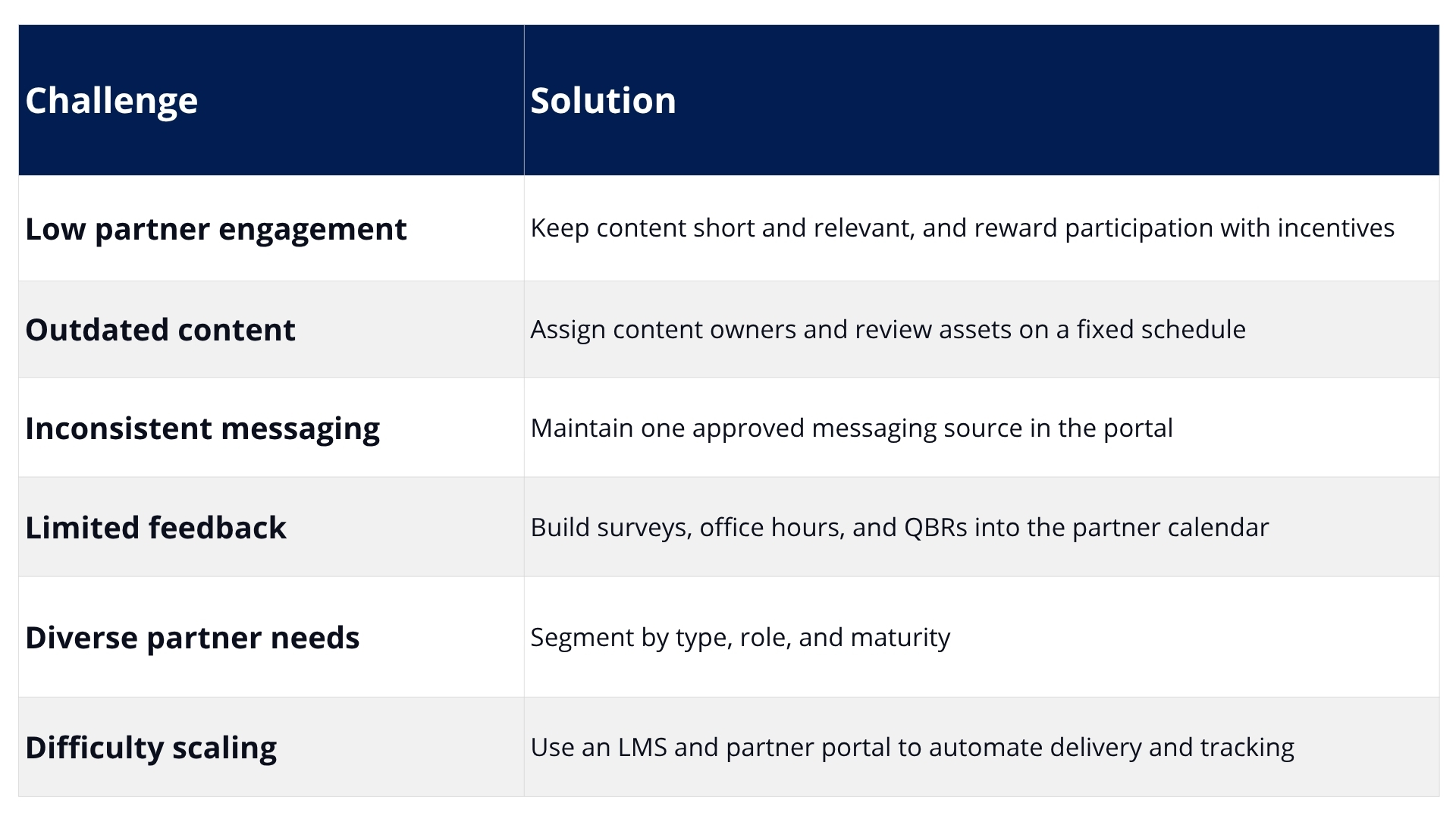
Want more tips from Fielo on enabling channel partners to get the most out of your relationships with them? Download our Partner Enablement Checklist.
How to Build a Partner Enablement Strategy
A partner enablement strategy connects all the checklist items into one repeatable process:
- Define goals: Set business KPIs and enablement metrics.
- Segment partners: Group them by type, role, and maturity.
- Assess needs: Identify knowledge and skill gaps in each segment.
- Create content: Build training, playbooks, and customer-ready assets.
- Onboard: Guide new partners through structured partner onboarding.
- Train and certify: Verify competency with assessments and certifications.
- Provide tools: Centralize everything in a partner portal.
- Measure: Track leading indicators and business outcomes.
- Collect feedback: Gather input through surveys, office hours, and QBRs.
- Optimize: Update content and training based on results.
Strong communication with channel partners supports every step.
Conclusion
Partner enablement turns partners into a true extension of your sales team. With structured onboarding, practical training, customer-ready assets, and a single source of truth, partners can sell your products with confidence, and you can measure exactly how enablement drives revenue. To see how enablement fits into a wider program, read our guide to partner programs.
Want more tips from Fielo on enabling channel partners? Download our Partner Enablement Checklist, built from years of experience working with marketing and sales leaders in manufacturing.
If you're interested in learning more, reach out to take a closer look at Fielo today.
Frequently Asked Questions
What is partner enablement?
Partner enablement is the process of giving partners the knowledge, training, content, tools, and support they need to sell, market, implement, or support your offering.
What should a partner enablement plan include?
Clear goals and KPIs, partner segmentation, onboarding, product and sales training, certifications, a sales playbook, customer-ready assets, a partner portal, feedback loops, and performance measurement.
What are the pillars of partner enablement?
The core pillars are knowledge (training and certification), content (playbooks and sales assets), tools (portals and technology), support (coaching and partner managers), and measurement.
How do you measure partner enablement?
Combine enablement metrics, such as training completion and content usage, with business outcomes, such as partner-sourced pipeline, revenue, win rate, and time to first deal.
What is the role of partner managers?
Partner managers guide onboarding, coach partners, run QBRs, collect feedback, and connect partners with the resources they need to grow.
What is the difference between partner enablement and channel enablement?
The terms are largely interchangeable. Channel enablement usually refers to resellers and distributors, while partner enablement can also include MSPs, ISVs, and system integrators.