
In the modern B2B landscape, relying exclusively on your internal sales team places a hard ceiling on your revenue potential. To unlock exponential, capital-efficient growth, businesses must look outward and build robust networks of third-party partners.
This is exactly why partner programs are so critical. They provide the structured framework needed to enable, support, and scale your external sales channels effectively. Whether you are launching your first channel initiative or looking to optimize an existing network, this complete, beginner-friendly guide will walk you through what partner programs are, the key pillars of success, real-world examples, and the best practices required to turn third-party vendors into your most powerful brand advocates.
A partner program is a formal business strategy where a vendor provides resources, training, marketing tools, and financial incentives to third-party organizations so they can successfully market, sell, and support the vendor’s products.
In simple business terms, it is the collaborative ecosystem that helps vendors enable, manage, and motivate their partners. Instead of treating distributors or resellers as simple transaction handlers, a structured partner program aligns the financial and strategic goals of both parties, ensuring that external partners are just as equipped and motivated to sell as your own internal sales force.
Depending on your industry and go-to-market strategy, partner programs can take several forms. The most common types include:
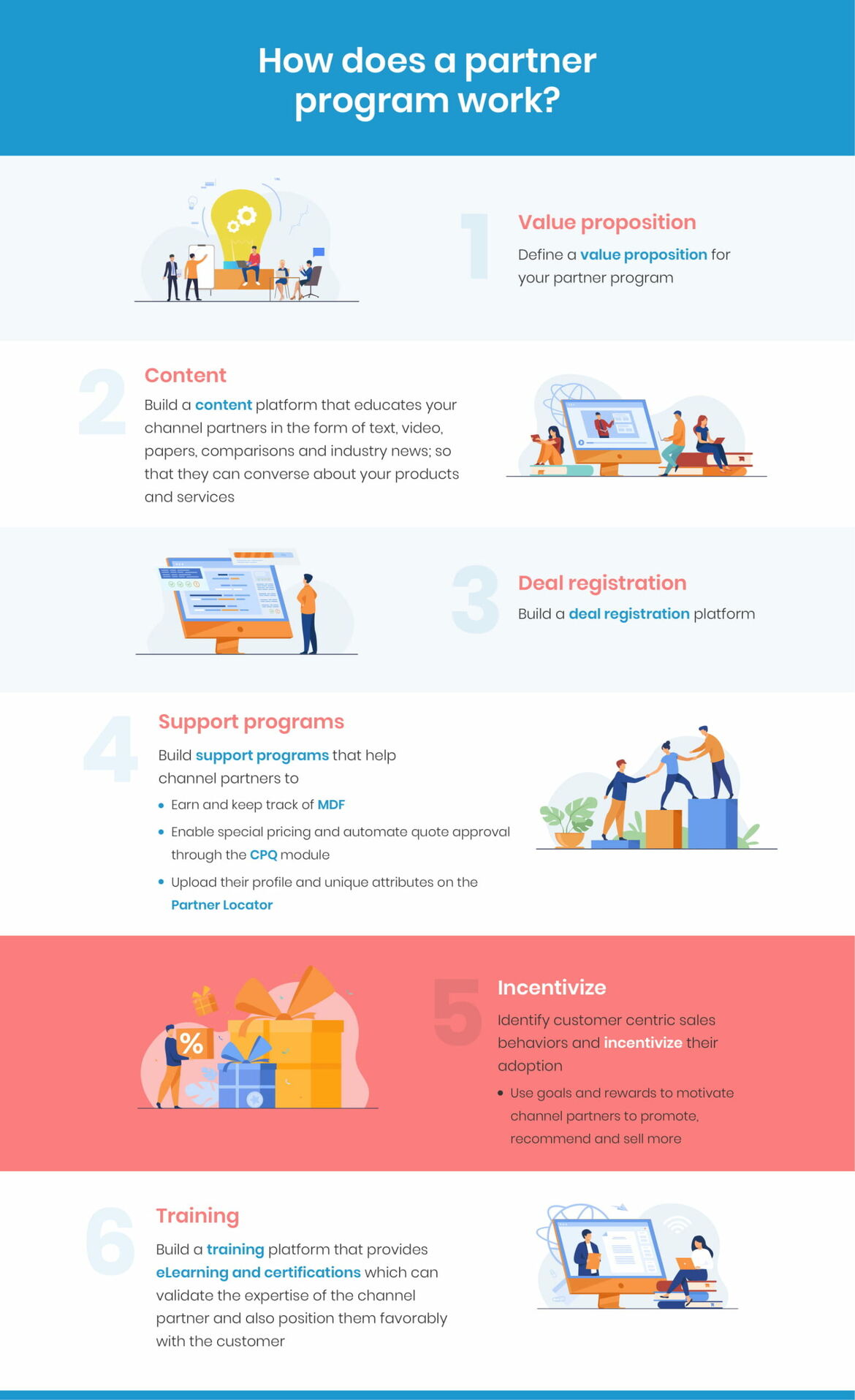
To ensure your partners have everything they need to succeed without causing massive administrative headaches for your internal team, your program must be built upon these seven foundational pillars:
Pillar 1: Content and Digital Asset Management
Partners cannot sell what they cannot market. A robust program provides a centralized hub where partners can access the latest co-branded marketing assets, datasheets, and brochures. A Digital Asset Management (DAM) tool empowers them to localize and personalize content while maintaining 100% brand and legal compliance.
Pillar 2: Business and Deal Registration
Channel conflict, where internal reps and external partners fight over the same lead, destroys trust. A transparent deal registration system allows partners to log their active leads. This protects their margins, rewards them for sourcing the deal, and gives vendors clear visibility into the upcoming pipeline.
Pillar 3: Market Development Funds (MDF)
To help partners penetrate local markets, vendors provide MDF budgets. These funds are allocated to partners to subsidize their local demand-generation efforts, such as hosting webinars, running digital ads, or attending trade shows.
Pillar 4: Configure, Price, Quote (CPQ) Tools
Complex B2B sales often require customized pricing. Providing partners with CPQ tools ensures they can quickly and accurately generate quotes for their clients without having to wait days for internal vendor approvals, drastically accelerating pipeline velocity.
Pillar 5: Partner Locator Systems
A partner locator is a tool on the vendor’s website that helps end consumers find certified local partners or installers. By routing high-quality leads directly to the partners who have completed their product certifications, vendors provide a massive value-add that drives partner loyalty.
Pillar 6: Partner Training and Enablement
A partner who does not understand your product will not sell it. Providing a seamless Learning Management System (LMS) ensures partners are continually educated on new features, installation guidelines, and sales techniques through accessible, on-demand modules.
Pillar 7: Incentive Program Management
This is the engine that drives engagement. Incentive management tracks partner behaviors, like training completion, deal registration, or sales volume, and automatically fulfills rewards such as points, rebates, or tier upgrades.
Leading brands use structured platforms to drive massive results in their partner ecosystems:
A robust partner program is the ultimate vehicle for achieving scalable, capital-efficient growth. By equipping your third-party networks with the right training, tools, and targeted rewards, you transform loosely coupled vendors into fiercely loyal brand advocates. However, managing the complex pillars of content, MDF, deal registration, and incentives manually is a recipe for data silos and partner frustration.
To execute these strategies seamlessly, modern brands rely on specialized platforms like Fielo. Fielo’s Channel Performance Suite integrates natively with Salesforce and Open Cloud environments, combining learning management, digital asset distribution, MDF tracking, and automated incentives into one powerful engine. With Fielo, businesses can eliminate administrative bottlenecks and scale their partner programs with confidence and intelligence.
A partner program is a structured business strategy where a vendor provides resources, tools, and incentives to third-party organizations to help them market, sell, and support the vendor’s products effectively.
The main types include Value-Added Resellers (VARs), distributors, referral/affiliate partners, and Managed Service Providers (MSPs).
Incentives are crucial because they motivate partners to engage with your enablement tools, prioritize your products over competitors, and align their daily sales behaviors with your company's strategic goals.
Successful examples include Schneider Electric's global partner portal that incentivizes e-learning and lead management, and Gutterglove's Contractor Alliance Program which blends training, marketing support, and automated rewards.
They drive revenue by exponentially expanding a brand's sales footprint and market reach without the high overhead costs of hiring a massive internal sales force.
Managing a program at scale requires a Partner Relationship Management (PRM) platform, a Learning Management System (LMS) for training, a Digital Asset Management (DAM) hub for marketing, and an automated incentives engine.
Common challenges include channel conflict over lead ownership, low partner engagement due to complex or disjointed portals, and delayed incentive payouts caused by manual spreadsheet calculations.
Success is measured by tracking key performance indicators such as partner engagement rates, training completion, MDF utilization, pipeline generation, and overall channel revenue contribution.

.png)