
.png)


Customer retention measures how effectively a business keeps its existing customers over time - a vital performance indicator tied directly to growth and profitability. In today’s market, retaining customers often matters more than acquiring new ones because loyal customers spend more, refer others, and cost less to maintain. This article explores what customer retention truly means, why it’s essential, how to measure it with key metrics, and proven customer retention strategies - complete with real-world examples of brands turning retention into a long-term growth engine.
What Is Customer Retention?
Customer retention refers to a company’s ability to maintain ongoing relationships with its customers and keep them engaged over time. It involves encouraging repeat purchases, renewing subscriptions, or deepening brand loyalty through positive experiences. A high retention rate indicates that customers find consistent value in what a brand offers. Ultimately, a consumer retention strategy isn’t about preventing churn, it’s about creating an experience so satisfying that customers naturally choose to stay.
Customer Retention vs. Churn vs. Loyalty
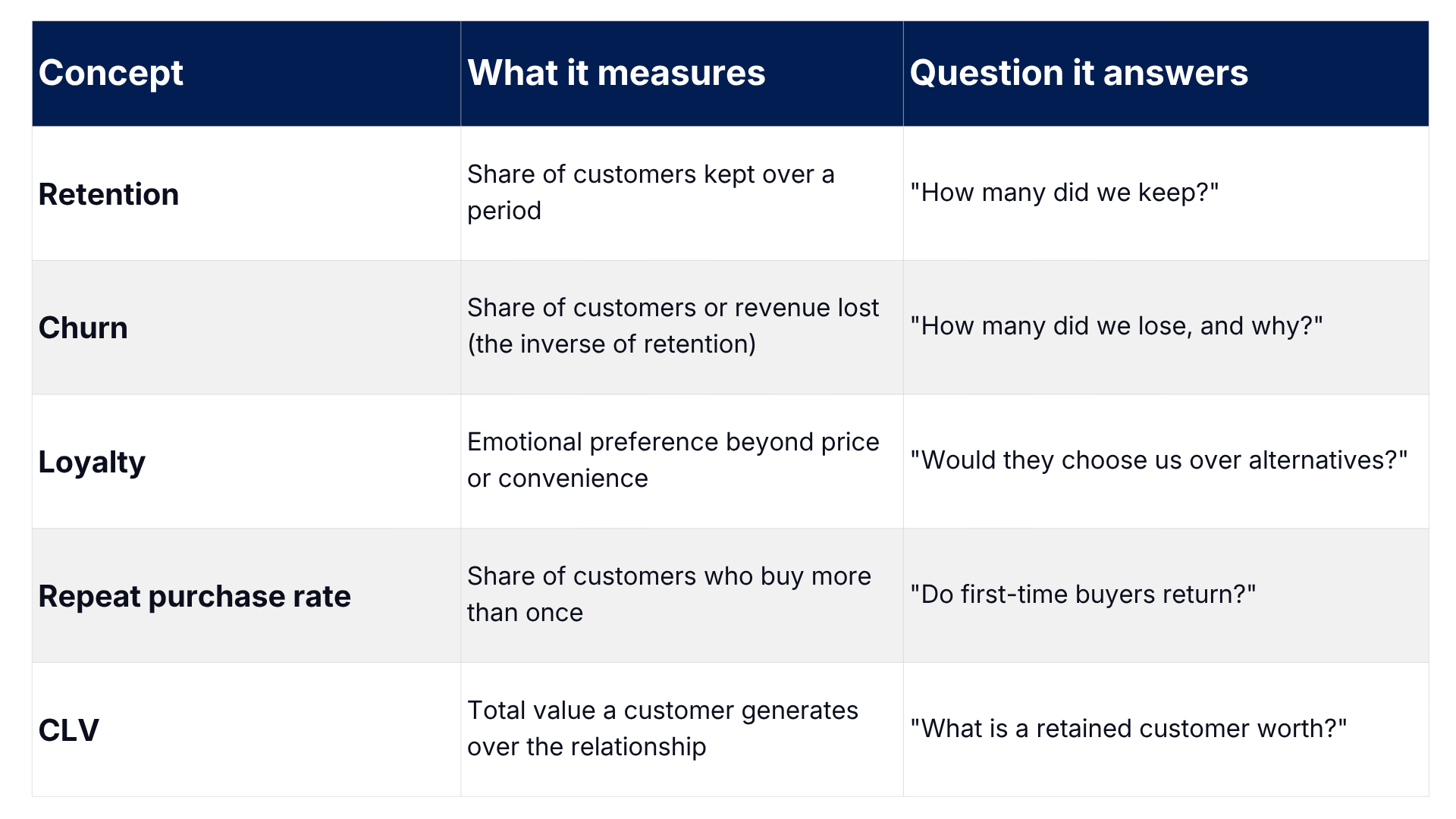
A customer can be retained without being loyal, for example when locked into a contract. Loyalty is what makes retention last. See customer loyalty vs. customer retention.
Why Customer Retention Is Critical For Business Growth
According to Harvard Business Review, acquiring a new customer costs five to 25 times more than keeping one, and Bain & Company research found that a 5% increase in retention raises profits by 25% to 95%. Retention drives growth in four ways:
- Higher CLV: Every renewal or repeat purchase adds to customer lifetime value without new acquisition cost.
- More revenue: The chance of selling to an existing customer is 60–70%, versus 5–20% for a new prospect (Marketing Metrics).
- Lower acquisition costs: Less churn means fewer new customers are needed just to stay level.
- Predictable growth: Retained customers create recurring revenue and refer others.
Factors Affecting Customer Retention
- Customer experience: Friction at any touchpoint is a common churn trigger.
- Product quality: No program can compensate for a product that underdelivers.
- Support: Fast, effective resolution turns bad moments into trust.
- Value: Customers constantly weigh price against what they get.
- Personalization: Relevance shows you understand the customer.
- Convenience: Easy reordering and smooth payments are critical for ecommerce customer retention.
- Trust: Transparent pricing, data privacy, and kept promises.
Customer Retention Funnel
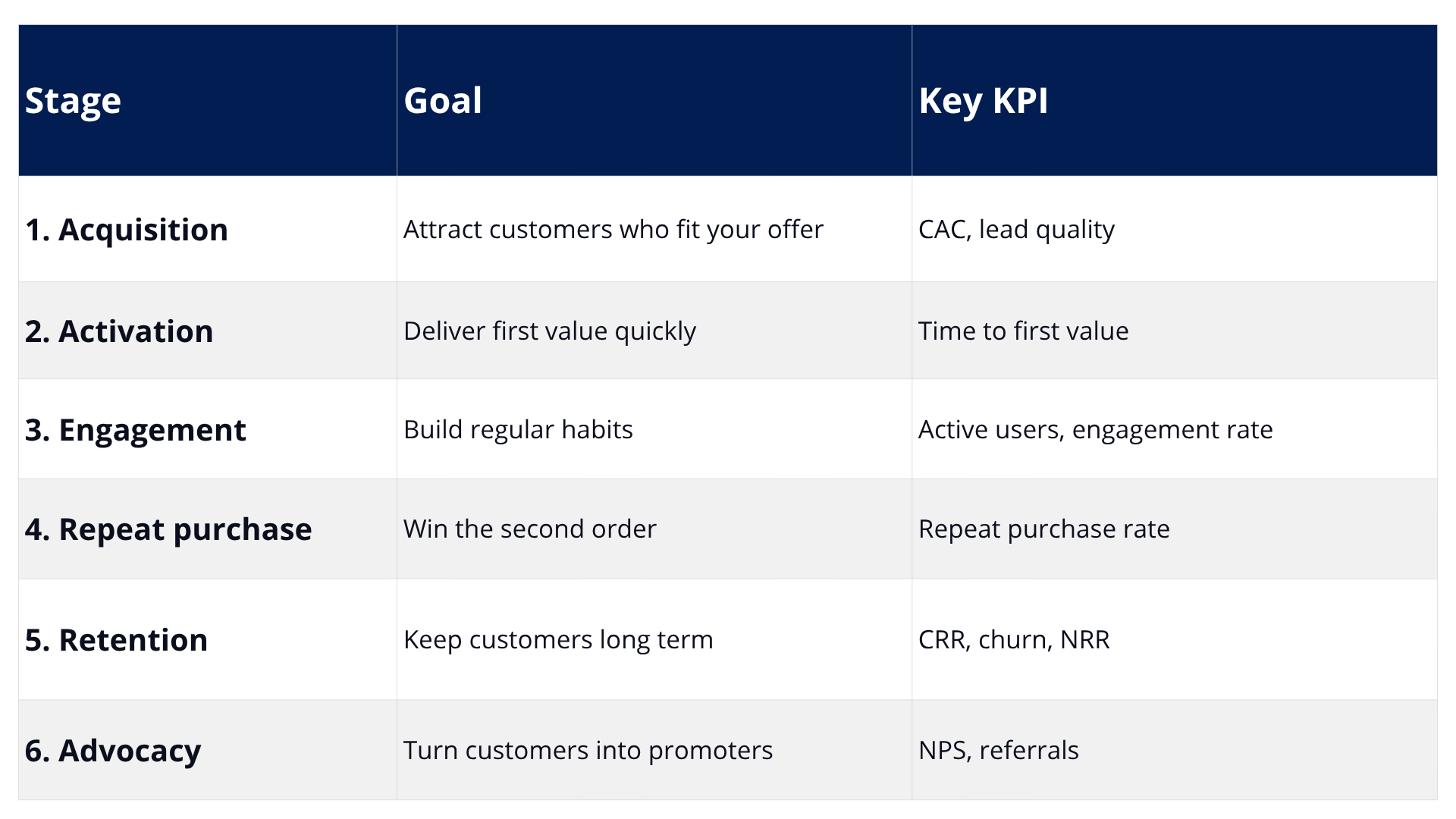
Weak activation undermines everything downstream. See the customer lifecycle.
Customer Retention Rate Calculation
To measure retention effectively, businesses should monitor several key performance metrics:
- Customer Retention Rate (CRR): The percentage of customers a company retains over a certain period, calculated as
CRR = (E−N) / S × 100
where E = ending customers, N = new customers acquired, S = starting customers
Worked example: A retailer starts the quarter with 1,000 customers, gains 200, and ends with 1,050.
- 1,050 − 200 = 850 retained customers
- 850 ÷ 1,000 = 0.85
- CRR = 85%, so churn is 15%
Skipping the subtraction gives 105%, hiding the 150 customers who left.
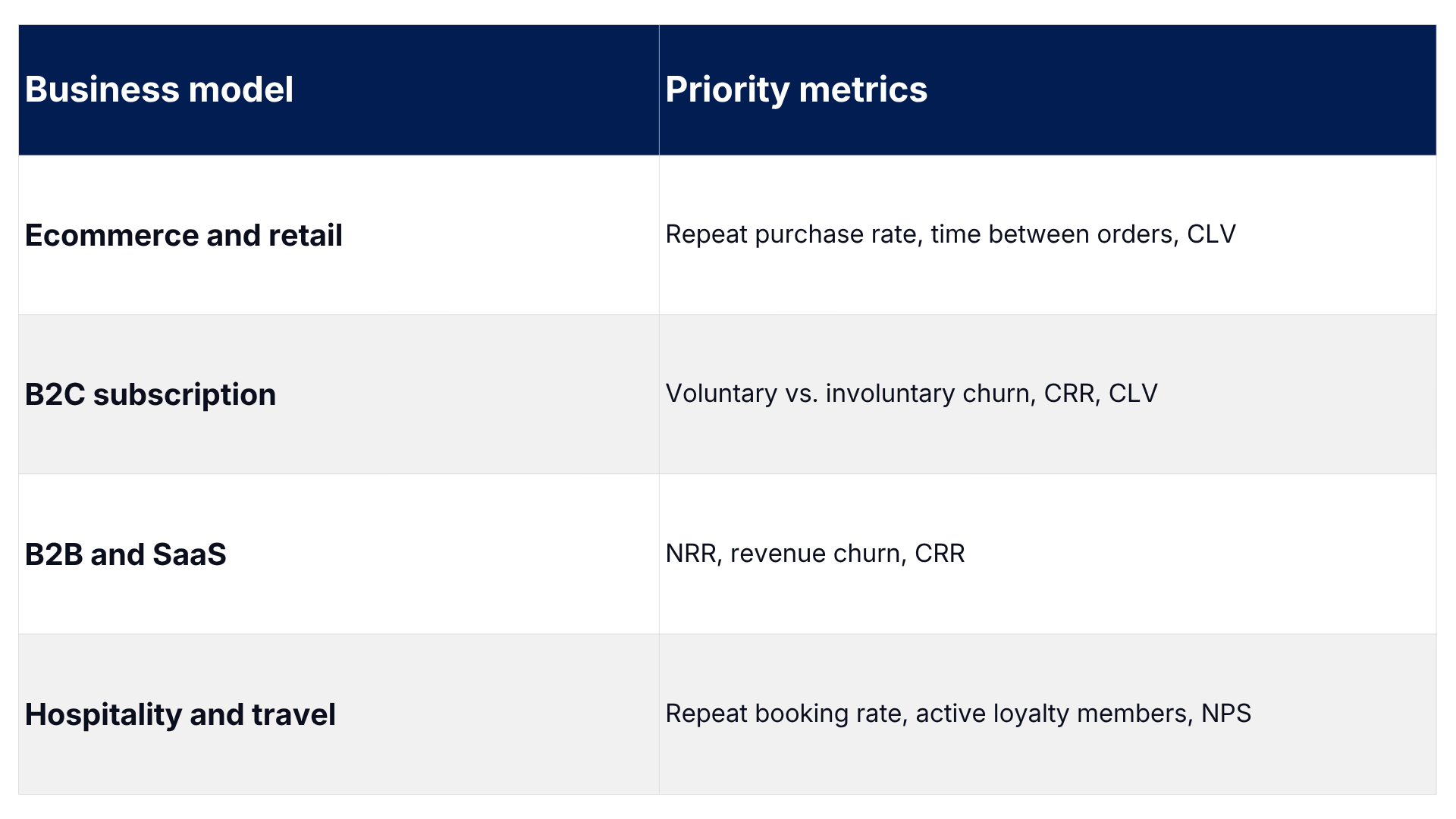
Customer Retention Metrics
- Customer Retention Rate (CRR): Percentage of customers kept, using the formula above.
- Churn Rate: Customers lost ÷ customers at start × 100. Split subscription churn into voluntary (cancellations) and involuntary (failed payments).
- Revenue Churn: Revenue lost to cancellations and downgrades ÷ starting revenue. It shows when losing a few large accounts hurts more than many small ones.
- Net Revenue Retention (NRR): (Starting revenue + expansion − contraction − churn) ÷ starting revenue. Example: $100,000 + $12,000 − $3,000 − $5,000 = $104,000, so NRR is 104%. Above 100% means existing customers alone grow revenue.
- Customer Lifetime Value (CLV): Total revenue per customer over the relationship.
- Repeat Purchase Rate (RPR): Customers with two or more purchases ÷ total customers.
- Net Promoter Score (NPS): Likelihood to recommend; a leading indicator of churn.
What Is a Good Retention Rate?
There is no universal benchmark, because retention depends on industry, purchase frequency, and contracts. Averages run from about 84% in media and professional services to 55% in hospitality:
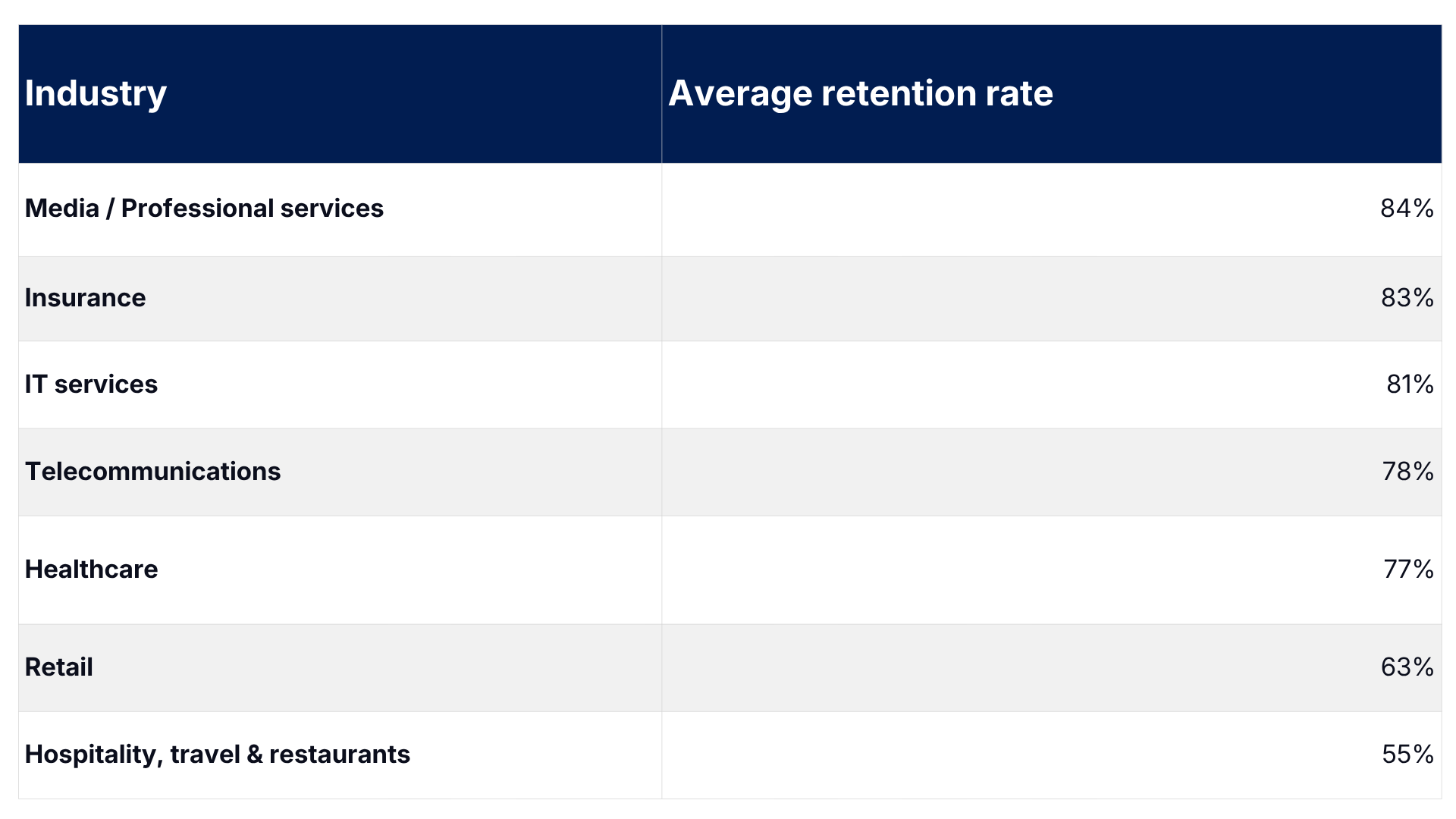
Ecommerce is lowest, at around 38%, while B2B SaaS averages about 90%. Benchmark against your own history and direct peers, and segment by cohort and tier: a 60% overall rate can hide 90% among loyalty members.
Top Customer Retention Strategies
High-performing companies implement proactive strategies to build long-term loyalty and engagement:
1. Personalized Experiences
- How: Unify customer data, segment by behavior, and trigger tailored offers and recommendations.
- Example: A fashion retailer sends style picks and size-specific restock alerts.
- KPIs: Repeat purchase rate, revenue per customer.
2. Exceptional Customer Support
- How: Set response-time targets, empower first-contact resolution, and tag tickets to fix root causes.
- Example: A travel brand rebooks delayed customers before they call.
- KPIs: First-contact resolution, CSAT.
3. Customer Onboarding Programs
- How: To reduce churn early, define the "first value" moment, guide new customers there within days, and follow up with anyone who stalls.
- Example: A meal-kit service sends a quick-start guide before the first box arrives.
- KPIs: Time to first value, 90-day retention.
4. Loyalty and Rewards Programs
- How: Build a customer retention program with simple earning, aspirational tiers, and emotional perks like early access.
- Example: A retailer gives top-tier members exclusive events.
- KPIs: Active member rate, member vs. non-member CLV.
5. Customer Feedback Loops
- How: Survey at key moments, review themes monthly, and tell customers what changed.
- Example: A software company publishes quarterly "you asked, we built" updates.
- KPIs: NPS, churn among detractors.
6. Consistent Communication
- How: Plan a cross-channel calendar mixing education, appreciation, and offers.
- Example: A skincare brand times replenishment reminders to product lifespan.
- KPIs: Engagement rate, unsubscribe rate.
7. Proactive Retention Campaigns
- How: Define churn signals, score customers by risk, and automate tiered win-back outreach.
- Example: An ecommerce brand sends an offer when a customer exceeds 1.5 times their usual order gap.
- KPIs: Win-back rate, churn by risk segment.
8. Payment Recovery to Reduce Involuntary Churn
Involuntary churn makes up 20–40% of subscription churn (Paddle).
- How: Use smart retries, dunning emails, card updaters, and pre-expiry reminders.
- Example: A streaming service requests a new card before renewal fails.
- KPIs: Payment recovery rate, involuntary churn rate.
How to Build a Customer Retention Strategy
Here is how to improve customer retention systematically:
- Set goals: Pick one primary metric, record a baseline, and set a time-bound target.
- Segment customers: Group by value, behavior, lifecycle stage, and channel.
- Identify churn signals: Study lost customers to find warning signs and build a risk score.
- Design interventions: Match each segment and risk level to a specific response.
- Measure impact: Use control groups to prove each tactic works.
- Optimize: Review monthly, scale winners, and drop what doesn't work.
Customer Retention Examples: Real-Life Case Studies
Netflix: Predictive personalization
- Tactic: Predictive analytics personalize recommendations, rows, and artwork.
- Outcome: Netflix executives estimated in 2015 that personalization saves more than $1 billion a year by reducing cancellations.
- Takeaway: When customers can leave anytime, make value effortless to find.
Apple: Ecosystem retention
- Tactic: Integration across devices and services such as iCloud, iMessage, and Apple Watch.
- Outcome: Switching means losing seamless experiences, making Apple one of the most loyalty-rich brands in tech.
- Takeaway: Make products more valuable together than apart.
Sephora: Tiered emotional loyalty
- Tactic: Beauty Insider tiers with birthday gifts, early access, and consultations.
- Outcome: 45 million North American members who drive the majority of sales.
- Takeaway: Tiers and experiences build loyalty that discounts can't.
Customer Retention Challenges
- Competition: Low switching costs make trying alternatives easy.
- Rising expectations: Customers compare you with the best experience they've had anywhere.
- Poor onboarding: Customers who don't reach value quickly leave early.
- Personalization gaps: Brands lack the data or tools to personalize at scale.
- Fragmented data: Siloed systems hide churn signals.
- Hidden involuntary churn: Failed payments get mistaken for cancellations.
Common Customer Retention Mistakes To Avoid
Even the most well-intentioned retention efforts can fail if businesses overlook critical pitfalls:
- Ignoring feedback: Respond to complaints fast and share what you changed.
- Overemphasizing acquisition: Set retention KPIs and budget, and report CAC alongside CLV.
- Inconsistent communication: Use a shared calendar and automate lifecycle messages.
- Lack of personalization: Start with key segments (new, VIP, at-risk) and expand.
- Complicated loyalty programs: Make rewards explainable in one sentence with a quick first win.
- Neglecting onboarding: Map the first 30 days and follow up with anyone who stalls.
Conclusion
A customer (or consumer) retention strategy is more than a marketing initiative, it’s a growth strategy rooted in value creation and relationship building. In today’s competitive markets, companies that master retention outperform those chasing constant acquisition. Retained customers contribute higher lifetime value, stronger advocacy, and more stable revenue streams. Businesses that prioritize experience, personalization, and trust unlock the full potential of customer relationships - turning everyday transactions into long-term partnerships that drive profitability and resilience.
At Fielo, we believe that customer retention plays a pivotal role in sustaining business growth. By focusing on retaining existing customers, businesses can save on acquisition costs while maximizing the value of each customer relationship. Loyal customers not only generate repeat purchases but also act as brand advocates, referring new customers and amplifying the brand's reach.
Frequently Asked Questions
What are customer retention strategies?
Methods businesses use to keep customers engaged and buying, such as personalization, loyalty programs, onboarding, and proactive support.
How do you calculate customer retention rate?
CRR = ((E − N) / S) × 100. Starting with 1,000 customers, adding 200, and ending with 1,050 gives 85%.
What is a good customer retention rate?
It varies by industry, from about 55% in hospitality to 84% in media. Compare against your own history and direct peers.
What is the difference between customer retention and churn?
Retention is the share of customers you keep; churn is the share you lose. 85% retention equals 15% churn.
What is the difference between customer retention and customer loyalty?
Retention measures repeat behavior, while loyalty reflects emotional preference beyond price or convenience.
How can businesses improve customer retention?
Find out why customers leave, then improve onboarding, personalize communication, reward loyalty, and act on churn signals early.
What is involuntary churn?
Churn caused by failed payments rather than cancellations. Reduce it with smart retries, dunning emails, and card updaters.
How do you improve ecommerce customer retention?
Focus on the second purchase with follow-ups, replenishment reminders, and a simple loyalty program. See commerce loyalty.
How do client and consumer retention strategies differ?
B2B client retention centers on relationships and ROI; B2C consumer retention centers on satisfaction and convenience.
How can loyalty programs help improve customer retention?
They reward repeat business and build emotional bonds through recognition and exclusive benefits.