.png)

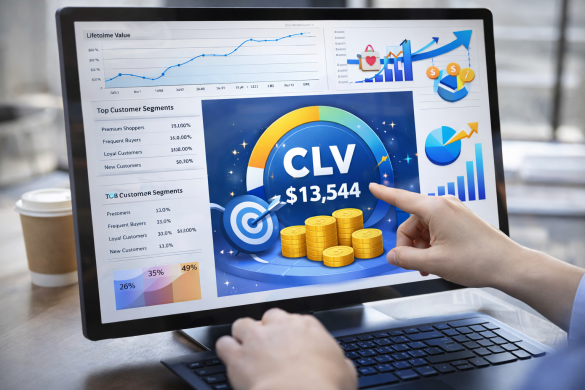
Customer Lifetime Value (CLV) measures the total revenue a business can expect from a single customer over the entire duration of their relationship. In today’s competitive market, CLV is one of the most important metrics for understanding long-term growth and profitability. It helps companies identify high-value customers, optimize retention strategies, and allocate marketing budgets effectively. In this article, you’ll learn what CLV is, why it matters, how to calculate it, and actionable strategies to increase it - with formulas and real-world examples to guide you.
What Is Customer Lifetime Value (CLV)?
Customer Lifetime Value (CLV) or Client Lifetime Value, sometimes called LTV, represents the total worth of a customer to a business over time. It’s not a one-time figure but a projection based on purchase frequency, average order value, and retention rate. High CLV customers generate more profit with lower acquisition costs, making them crucial to sustaining growth. Businesses that understand CLV can better focus on keeping their best customers engaged while improving marketing efficiency and operational strategy.
Why Customer Lifetime Value Matters For Businesses
CLV gives companies a long-term view of profitability by showing the future value of existing customers. It helps organizations make smarter decisions about acquisition spending, pricing, product development, and customer experience. When CLV rises, it’s often a sign that customer retention, satisfaction, and cross-selling are improving. Additionally, CLV serves as a reliable benchmark for forecasting revenue and aligning leadership decisions around customer-centric growth. In essence, CLV is not just a number - it’s a lens for understanding and optimizing customer relationships.
Key Components Of Customer Lifetime Value
Several critical factors combine to determine CLV:
- Average Purchase Value (APV): The average amount spent per transaction.
- Purchase Frequency Rate (PFR): How often the customer makes purchases during a set timeframe.
- Customer Lifespan: The total time (in years or months) a customer remains active.
- Gross Margin: The profit margin on each sale after deducting costs.
- Retention Rate: The percentage of customers who continue buying over time.
- Discount Rate: Adjusts for inflation or time-based changes in value when projecting future earnings.
Together, these metrics help businesses calculate an accurate lifetime value and segment customers based on profitability potential. CLV is shaped by how well brands manage each customer lifecycle stage, from acquisition through advocacy.
Factors Affecting Life Time Value Of Customers
CLV is influenced by both internal and external factors. Key elements include:
- Customer Experience Quality: Great experiences drive loyalty; poor service shortens lifespan.
- Pricing and Promotions: Aggressive discounts may attract short-term buyers but lower profitability.
- Product or Service Quality: Reliable offerings build trust and repeat purchases.
- Customer Support Effectiveness: Quick, empathetic responses increase satisfaction and retention.
- Brand Loyalty and Advocacy: Strong emotional bonds with a brand lead to organic referrals and longer relationships.
- Market Competition and Substitution: Easier switching options can reduce CLV if differentiation is weak.
Understanding these factors allows businesses to identify improvement areas and mitigate churn risks effectively.
How To Calculate Customer Lifetime Value (CLV)
The most common customer lifetime value calculation uses three key data points: average purchase value, purchase frequency, and average customer lifespan. The simplified formula is:
CLV = (Average Purchase Value × Purchase Frequency) × Average Customer Lifespan
Modern analytics systems and CRM tools can automate CLV calculations by tracking purchase histories, churn probabilities, and cohort behaviors - helping marketers design more accurate retention campaigns.
Different Types Of Customer Lifetime Value
Businesses use different CLV models based on data availability and business maturity:
- Historical CLV: Based on past customer revenues and costs. Easy to calculate but doesn’t predict future behavior.
- Predictive CLV: Uses machine learning or statistical models to forecast value based on purchase patterns, engagement, and churn risk.
- Segmented CLV: Calculates CLV for specific customer groups (e.g., by region, subscription tier, or acquisition channel).
- Individual CLV: Personalized lifetime value based on individual-level transaction data, common in advanced analytics environments.
Each model serves distinct strategic goals - from baseline metrics to forecasting and personalization.
How To Improve Customer Lifetime Value
Boosting CLV requires improving both customer satisfaction and retention. Key strategies include:
- Enhancing onboarding experiences to set expectations and drive early engagement.
- Introducing loyalty programs that reward not just purchases but referrals and advocacy.
- Personalizing offers and communications based on behavior and preferences.
- Upselling and cross-selling relevant products to increase average order value.
- Proactive retention efforts, like timely outreach to churn-risk customers.
Improving CLV is a continuous process - each interaction should reinforce value, trust, and emotional connection.
Common Mistakes When Calculating (CLV)
Businesses often miscalculate CLV by overlooking critical elements such as churn rate, cost of service, or margin variability. Other errors include treating all customers as identical, ignoring discount rates, or relying only on past data without predictive modeling. Overestimating customer lifespan or underestimating acquisition costs can lead to inflated numbers and misguided investments. To avoid these pitfalls, always use reliable, clean data and revisit your CLV models regularly to align them with shifting market dynamics.
Conclusion
Customer Lifetime Value is the cornerstone of modern customer strategy. It quantifies the long-term impact of every acquisition, experience, and retention initiative. A high CLV reflects strong loyalty, efficient marketing, and meaningful brand relationships. By calculating and optimizing CLV, businesses can allocate resources more intelligently and focus on what truly matters - building lasting customer connections that fuel sustainable growth and profitability.
Frequently Asked Questions
What is meant by customer lifetime value?
It’s the total revenue a business expects to earn from a customer throughout their relationship, reflecting profitability and loyalty.
How do you calculate customer LTV?
Multiply average purchase value by purchase frequency, then by customer lifespan. Adjust for margins or use DCF for greater precision.
What is an example of a CLV?
If a customer spends $100 annually for five years with a 50% margin, their CLV is $250 (100 × 5 × 0.5).
What is the 80/20 rule in CLV?
It’s the Pareto Principle. It states that roughly 80% of profits come from 20% of customers - emphasizing focus on top-value segments.
What types of customer loyalty programs are most effective for CLV purposes?
Tiered loyalty programs, personalized, or hybrid programs combining rewards with experiences drive the highest retention and CLV growth.